





ElectROBOT vs Traditional Robotics: The New Standard
January 6, 2026
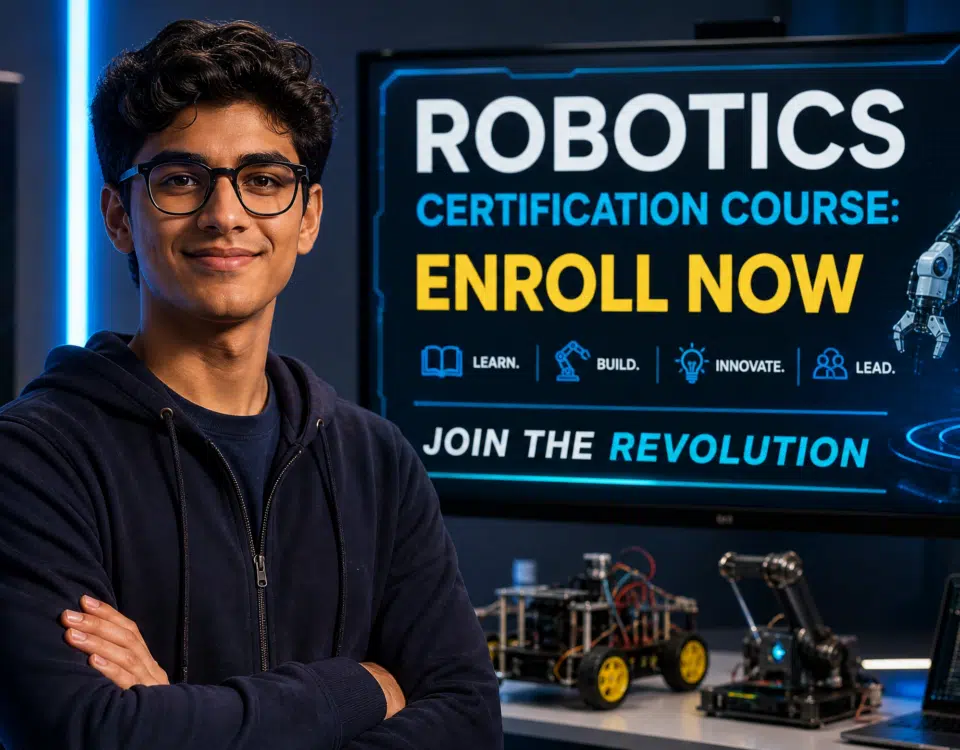
Robotics Course With Certification for Future Engineers
March 16, 2026
In an era where technology evolves at lightning speed, moving from curiosity to real-world creation requires more than self-learning and random tutorials. Learners today need a clear, structured pathway that builds confidence alongside competence. The ElectROBOT robotics course offered by Embedded School is designed to serve as that essential bridge, guiding individuals step by step from foundational concepts to advanced, hands-on innovation.
What makes this journey powerful is its inclusivity and depth. Whether you are a school student discovering technology for the first time, a college graduate seeking industry-ready skills, or a working professional aiming to upskill, the ElectROBOT robotics course adapts to your stage of learning. Through a carefully designed curriculum and practical exposure, the ElectROBOT robotics course transforms learners into creators who can design, build, and innovate with confidence in a rapidly evolving technological world.
Table of Contents
From Playful Bots to Intelligent Innovation
Robotics has journeyed from the pages of science fiction into the rhythm of everyday life. What was once limited to industrial floors and research labs now exists in homes, classrooms, and creative spaces around the world. As intelligent systems become more accessible, robotics education can no longer be confined by age or background. The future belongs to those who do not merely operate technology but truly understand how it thinks, reacts, and evolves.
A Fundamental Shift in Robotics Learning
In the past, robotics was often perceived as a highly specialized discipline reserved for researchers and large-scale industries. That perception has changed dramatically. Today, learning robotics is about accessibility, curiosity, and practical application. The ElectROBOT robotics course reflects this shift by opening doors to structured robotics education for learners at every stage, transforming a once-exclusive field into an inclusive innovation pathway.
Learning Beyond Age Barriers
Why should problem-solving and logical thinking wait for adulthood? Curiosity has no age limit, and neither should education. Early exposure to robotics helps develop analytical thinking, creativity, and confidence long before career decisions are made. By encouraging hands-on exploration from a young age, the ElectROBOT robotics course nurtures builders and thinkers who grow alongside technology rather than chasing it later.
The Power of a Structured Learning Ecosystem
Many aspiring learners struggle not because of lack of interest, but due to unstructured learning paths. Jumping directly into advanced projects without understanding fundamentals often leads to confusion and frustration. A structured ecosystem ensures that each concept builds naturally on the previous one, creating clarity, continuity, and confidence throughout the learning journey.
Bridging Curiosity and Career Readiness
Embedded School’s mission is to transform fascination into capability. Robotics should be more than assembling gadgets—it should be about understanding systems, solving real problems, and preparing for future careers. Learners are guided from playful experimentation to purposeful innovation, gaining both technical depth and practical direction along the way.
By emphasizing the transition from “Buddy to Innovator,” this learning approach offers a clear roadmap for mastering intelligent machine development—keeping the experience engaging, meaningful, and aligned with real-world demands.
What is the ElectROBOT Robotics Course?
At its core, the ElectROBOT robotics course is a multidisciplinary training program that blends electronics, mechanical design, and computer programming. While many programs focus solely on “drag-and-drop” coding, the ElectROBOT robotics course at Elysium Embedded School dives deeper into the physical hardware.
-
Defining the Path: The ElectROBOT robotics course is a step-by-step framework for mastering autonomous systems.
-
The Philosophy: Our “Buddy to Innovator” approach ensures that students first view robots as companions before learning to build them as creators.
-
Beyond Kits: While traditional programs use closed-box kits, the ElectROBOT robotics course uses open-source components and real-world tools.
-
Core Pillars: The ElectROBOT robotics course focuses on three pillars: Embedded Systems, Electronics Design, and Algorithmic Intelligence.
By participating in the ElectROBOT robotics course, learners gain a profound understanding of microcontrollers—the “brains” of the machine. The ElectROBOT robotics course empowers students to move beyond kits and start creating proprietary designs.
Why Structured Robotics Learning Matters at Every Age
In the digital age, information is everywhere, but wisdom is rare. Many enthusiasts attempt to learn robotics through unstructured YouTube tutorials or random hobby kits. This often leads to “knowledge gaps” where a learner might know how to copy code but doesn’t understand the underlying electronics.
-
Eliminating Chaos
-
Building Confidence
-
Clarity and Depth
-
A Roadmap for Success.
-
Age-Specific Outcomes
Unstructured learning is like building a house on sand. The ElectROBOT robotics course provides the bedrock of fundamental engineering principles, ensuring that whatever you build—whether it’s a simple line follower or a complex industrial arm—is built on solid ground. At Embedded School, we believe that the ElectROBOT robotics course is the best investment a curious mind can make.

Robotics Learning for Young Minds: The Buddy Stage
For young learners, technology often feels like pure magic—things move, react, and respond without obvious reasons. The Buddy Stage is designed to gently uncover that magic and replace it with understanding. Instead of memorizing concepts, children experience how simple ideas like cause and effect shape the behavior of machines, turning curiosity into confidence.
Learning Logic Through Play
At this stage, learning happens naturally through interaction. Friendly, child-focused robots respond to the logic students create, helping them realize that machines follow rules written by humans. This playful experimentation forms the foundation of problem-solving and logical thinking without the pressure of formal theory.
Building Skills Beyond Technology
Robotics education at a young age is not only about circuits and components. Creativity, structured thinking, patience, and curiosity are woven into every activity. Learners begin to approach challenges thoughtfully, learning how to test ideas, observe outcomes, and improve their solutions step by step.
A Safe Space to Explore and Experiment
Safety is central to early robotics learning. All activities use low-voltage components and age-appropriate tools, ensuring a secure environment where mistakes are encouraged as part of the learning process. Errors become opportunities to ask questions and discover better approaches.
Early Exposure That Creates Long-Term Advantage
Introducing robotics concepts early provides a strong academic edge in science, technology, engineering, and mathematics. Students who start young develop familiarity with core concepts long before they encounter them in school, allowing them to progress with confidence and clarity in later years.
From Screens to Real-World Creation
Hands-on learning plays a crucial role in this stage. Instead of passive screen time, learners build, touch, and test physical creations. Through the ElectROBOT robotics course, children explore basic electronics and sensors in a way that feels like play while quietly shaping an innovator’s mindset. The ElectROBOT robotics course helps young minds see the world differently—where every challenge is an opportunity to design, build, and improve.
Robotics for College Students: Building the Innovator Mindset
The transition from a college student to a confident engineer demands more than theoretical understanding. Employers and research teams look for individuals who can apply concepts, debug real systems, and justify engineering decisions. This stage of robotics learning is designed to close that gap by transforming academic knowledge into applied expertise.
From Theory to Applied Engineering
College learners move beyond introductory concepts and begin working with complex systems that reflect real-world engineering challenges. Advanced sensor integration, motor dynamics, and feedback mechanisms are introduced to help students understand how machines respond under real operating conditions. Concepts such as torque optimization, RPM control, and system stability are explored through hands-on experimentation rather than abstract equations.
Microcontroller Programming Without Training Wheels
Students gain practical experience programming industry-relevant microcontrollers using professional development environments. Instead of simplified interfaces, learners work directly with real tools and workflows used by engineers in production settings. Through the ElectROBOT robotics course, students develop confidence in writing, testing, and optimizing firmware that interacts directly with hardware. The ElectROBOT robotics course ensures learners understand not only how code works, but how it controls physical systems in real time.
Project-Centered Skill Development
Every learning module concludes with a tangible project that reinforces concepts through application. From intelligent robotic arms to autonomous systems and smart automation models, students graduate with a portfolio that demonstrates problem-solving ability, system design, and technical depth. These projects become valuable assets during interviews and academic evaluations.
A Launchpad for Careers and Research
Robotics training at this level directly supports final-year projects, competitive internships, and entry-level engineering roles. Learners gain the confidence to explain communication protocols, control algorithms, and system architecture clearly—skills that set them apart in technical interviews.
Collaboration That Mirrors Industry Practice
Team-based projects simulate real research and development environments where collaboration, documentation, and version control matter. Students learn how to communicate ideas, divide responsibilities, and integrate subsystems—preparing them for professional engineering teams.
By the end of this stage, learners are no longer passive recipients of knowledge. They emerge as engineers who can design, analyze, and defend their solutions with clarity and confidence—ready to take their place in advanced academic or industrial roles.

Robotics Training for Working Professionals
In the age of Industry 4.0, automation and intelligent systems are reshaping how industries operate. For working professionals, returning to a full-time academic program is rarely practical. What is needed instead is focused, outcome-driven training that delivers real technical value without disrupting existing careers.
Industry 4.0–Focused Skill Development
Modern industries rely on intelligent automation, real-time control, and seamless machine communication. Professionals gain exposure to industrial communication protocols, automated control strategies, and system-level integration used in smart factories and connected production environments. The ElectROBOT robotics course is designed to align directly with these evolving industrial requirements.
A Direct Path for Career Transitions
Many professionals seek to move from software roles into hardware-centric domains, or from traditional mechanical engineering into mechatronics and automation. This learning track provides a structured bridge between disciplines, enabling learners to understand embedded systems, electronics, and control logic without starting from scratch. The ElectROBOT robotics course acts as a practical gateway for professionals aiming to reposition themselves in high-growth technical roles.
Solving Real-World Industrial Challenges
Learning is anchored in real industrial scenarios rather than abstract exercises. Participants work on use cases such as predictive maintenance systems, warehouse automation workflows, smart monitoring solutions, and IoT-enabled control systems. These projects mirror real challenges faced in production environments, ensuring immediate workplace relevance.
Flexible Learning Built Around Work Commitments
Recognizing the demands of full-time employment, Embedded School offers flexible schedules and modular learning paths. Professionals can upskill efficiently without compromising their current roles, making learning sustainable and stress-free.
High-Value Networking and Mentorship
Professionals benefit not only from technical training but also from access to a strong peer network and experienced mentors. Collaborative learning environments foster knowledge sharing, industry insights, and long-term professional connections.
For working professionals, robotics education is ultimately about return on investment. Skills such as real-time operating systems, intelligent sensing, automation logic, and system integration translate directly into higher responsibility roles and better compensation. This training focuses on eliminating unnecessary theory and delivering only the high-impact skills that modern industries demand—making it a smart, future-focused career decision.
Learning Methodology at Embedded School
How learning happens matters as much as what is learned. Embedded School follows a hardware-first, lab-intensive approach designed to mirror real engineering environments.
Teaching Philosophy
-
Hands-on exposure from day one
-
Fully equipped lab sessions
-
Live mentorship from industry experts
-
Use of real-world tools and platforms
-
Iterative design and improvement cycles
This immersive methodology ensures learning retention, practical confidence, and real-world readiness.

Career Opportunities After Completing the ElectROBOT Robotics Course
The demand for robotics experts is skyrocketing across industries like healthcare, defense, and manufacturing. The ElectROBOT robotics course opens doors to several high-paying, future-proof roles.
-
Embedded Robotics Engineer: Use the skills from the ElectROBOT robotics course to design the next generation of smart devices and consumer electronics.
-
Automation Specialist: Apply ElectROBOT robotics course principles to optimize industrial production lines, saving companies millions in efficiency.
-
IoT Systems Developer: Combine hardware and software expertise gained in the ElectROBOT robotics course to build smart cities and connected infrastructure.
-
Robotics R&D Engineer: Advance the field of robotics by working in research labs on cutting-edge projects like space exploration or surgical robots after completing the course.
-
Firmware Developer: Focus on the “brain” of the machine, a role that is in high demand and heavily emphasized in the ElectROBOT robotics course.
Why Elysium Embedded School Stands Out
Choosing the right learning partner can define the direction of your entire career. In a field as dynamic as robotics and embedded systems, outdated knowledge or purely theoretical training can quickly limit growth. Embedded School stands apart by offering an education model built on relevance, rigor, and real-world impact. Our focus goes beyond teaching concepts—we prepare learners to thrive in demanding technical environments.
Industry-Aligned Curriculum That Evolves with Technology
Technology does not stand still, and neither does our curriculum. Elysium Embedded School continuously updates its learning modules to reflect current industry standards, emerging tools, and real engineering practices. From embedded systems and automation to intelligent robotics and IoT, every topic is designed to match what companies are actively using today—not what was relevant years ago. This ensures learners graduate with skills that are immediately applicable in the workplace.
Trainers with Real-World Engineering Expertise
At Embedded School, learning is guided by professionals who have built, deployed, and debugged real systems in the field. Our trainers bring hands-on industry experience into the classroom, sharing practical insights that go far beyond textbooks. Learners benefit from real case studies, practical problem-solving techniques, and mentorship that reflects actual engineering challenges faced in production environments.
Advanced Laboratory Infrastructure for Hands-On Mastery
True technical competence is developed through practice, not passive observation. Embedded School provides state-of-the-art laboratory facilities equipped with modern development boards, sensors, diagnostic tools, and testing equipment. Learners work in an environment that mirrors professional R&D labs, allowing them to gain confidence in handling hardware, troubleshooting circuits, and optimizing embedded code under real constraints.
Certification That Holds Real Industry Value
A certificate should represent more than course completion—it should signal proven capability. Certifications issued by Embedded School are backed by rigorous training, hands-on assessments, and project-based evaluations. Employers recognize this certification as evidence of practical expertise, system-level understanding, and readiness to contribute from day one.
Dedicated Placement and Career Support
Education is only meaningful when it leads to opportunity. Embedded School offers structured career support, including resume preparation, interview guidance, portfolio development, and placement assistance. Our strong industry connections and career-focused mentoring help learners transition confidently from training to employment, whether they are entering the workforce or advancing their careers.
Shaping Innovators, Not Just Students
At Embedded School, every learner is viewed as a future innovator and problem solver. We foster curiosity, critical thinking, and engineering confidence at every stage of learning. By combining structured education with real-world exposure, we empower learners to design, build, and innovate—rather than simply follow instructions.
Embedded School is not just a place to learn technology; it is a place to become part of the future that technology is shaping.
Frequently Asked Questions
1. Who can enroll in this robotics learning program?
This program is designed for a wide range of learners, including school students, college graduates, and working professionals. Structured learning paths are customized to suit different age groups and experience levels, ensuring everyone progresses at a comfortable and effective pace.
2. Is prior technical knowledge required to join?
No prior technical background is necessary. The program starts with core fundamentals such as basic electronics and logical thinking, then gradually advances to more complex concepts. This step-by-step approach makes learning accessible even for complete beginners.
3. What is the duration of the program?
The duration varies based on the learning track selected. Focused, intensive programs can be completed in around three months, while comprehensive tracks designed for deeper skill development typically span up to six months.
4. Is the program safe for young learners?
Yes. All training activities use safe, low-voltage components and age-appropriate tools. Sessions are conducted under expert supervision to ensure a secure and supportive learning environment for younger participants.
5. Will learners receive a recognized certification?
Yes. Upon successful completion of the program, learners receive a professional certification from Embedded School. This certification validates practical skills and technical knowledge, enhancing career opportunities in robotics and embedded systems.
Conclusion:
The journey from “Buddy to Innovator” is more than just a tagline; it is a life-changing transition. By choosing the ElectROBOT robotics course, you are moving from being a passive consumer of technology to an active creator of it. The ElectROBOT robotics course provides the structured environment, the expert mentorship, and the high-end hardware needed to make this leap successfully.
Don’t let the future happen without you. Be the one who builds it. Enroll in the ElectROBOT robotics course at Embedded School today and take your first step toward becoming a robotics innovator. Whether you are building your first “Buddy” robot or your tenth industrial “Innovator” project, the ElectROBOT robotics course will be with you every step of the way. Visit Elysium Embedded School to learn more about the ElectROBOT robotics course and join our community of creators.