






Build the Robots. Fly the Drones. Engineer India's Autonomous Future.

70% practical, 30% theory - Hands-on ratio

Robot chassis, quadcopter share, Pi 4, Pixhawk - Hardware per learner

45 days × 1.5 hrs = 67.5 contact hours - Duration

Embedron Robotics & Drones Certificate - Certification

Coordinated robot + drone industry mission - Capstone
Program Highlights
Start Your Learning Journey With Confidence
- Course Overview
- Course Objective
- Learning Outcomes
- Target Audience
- Course Features
- Industry & Job Connect
Robotics is no longer a research lab discipline. In India today, robots are sorting parcels for e-commerce giants, spraying pesticide-free formulations over Maharashtra vineyards, patrolling perimeters at strategic facilities, and delivering medicines to villages that road networks cannot reach. None of this happens without engineers who can blend mechanics, electronics, embedded firmware, communication, and intelligence into a single working system.
Embedron+ Module 3 is the third module of the flagship Embedron program from Elysium Embedded School, and it is the module where everything you learned about sensors, microcontrollers, and IoT in Modules 1 and 2 starts moving — literally. Over 45 days of 1.5-hour daily sessions, you go from understanding what a brushless motor is to flying a quadcopter you assembled and calibrated yourself, and from spinning a single DC motor with PWM to navigating a four-wheel mobile robot through a lab using SLAM-built maps and the Nav2 stack on ROS 2.
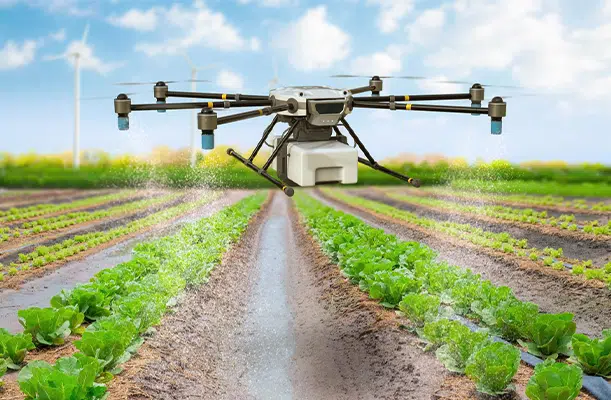
Why This Course Matters
Most Indian engineering graduates can describe a PID controller on paper but have never tuned one against a real load. They have read about ROS but never written a node that publishes encoder data to a live RViz model. They have seen a drone fly but have never sat at the Mission Planner console doing radio calibration, geofencing, and a tethered first hover. This course closes that exact gap. By the time you finish Module 3, you have done all of it — on hardware that is paid for, calibrated, and waiting for you on the bench.
Industry Relevance
Every capability taught in this module maps to a hiring signal recruiters at Bosch, L&T, Tata Elxsi, Ola Electric, Ather, ideaForge, Garuda Aerospace, and dozens of mid-sized AMR and agri-drone startups actively look for. ROS 2 is the lingua franca of warehouse robotics. ArduPilot and Pixhawk are the dominant stack for commercial Indian drones. PID tuning is the gatekeeper question in every motion-control interview. You will not just learn these things — you will have GitHub commits, video demos, and a capstone to prove you can use them.
Business Applications
The pattern matters more than the project. Once you can build a differential-drive robot that maps its surroundings and navigates autonomously, you can build a warehouse AMR for a fashion brand, a hospital delivery robot, a hospitality service bot, or an agri-rover for orchard inspection. Once you can program an autonomous waypoint mission on a Pixhawk drone, you can build a surveillance UAV, a crop-monitoring drone, a parcel-delivery scout, or an inspection drone for solar farms and transmission towers. Module 3 teaches you the underlying engineering grammar — the applications are limited only by imagination and demand.
Real-World Use Cases Embedded in the Module
- Edge AI and TinyML — running intelligence on tiny microcontrollers
- Industrial IoT — sensors and gateways across factory floors
- Smart agriculture and AgriTech drones
- Electric mobility and battery-management systems
- Defence and surveillance electronics
- Space-tech CubeSats and hobby-grade satellites
- Sustainable energy electronics — solar, micro-grids, battery storage
Beginner-to-Advanced Learning Journey
Week one starts gentle — geared DC motors, encoders, motor drivers, and the kinematics of differential drive. By week three you are writing ROS 2 nodes in both Python and C++ and visualising live transform trees in RViz. Week four flips the switch to autonomy with SLAM, AMCL, and Nav2. Weeks five and six push into the skies with full multirotor assembly, calibration, MAVLink scripting, and your first real autonomous flights. The final two weeks are dedicated to a track-specific capstone that demonstrates everything, on demo day, in front of a panel.
By the end of Module 3, every learner will be able to:










Technical Skills You Will Walk Away With
- ROS 2 Humble — nodes, topics, services, parameters, launch files, TF, URDF, RViz, Nav2, slam_toolbox.
- Embedded motion control — PWM, encoders, PID, motor drivers (L298N, BTS7960, TB6612FNG), brushless ESC fundamentals.
- Sensor stack — IMU sensor fusion (Madgwick, Mahony), ultrasonic and ToF distance sensing, 2D LiDAR, USB cameras.
- Computer vision — OpenCV with Python on Pi, ArUco detection, colour-based tracking, lane following.
- Drone hardware — frame assembly, BLDC + ESC pairing, prop balancing, Pixhawk wiring, GPS and telemetry setup.
- Drone software — ArduPilot configuration, Mission Planner, SITL simulation, MAVLink protocol, pymavlink and DroneKit scripting.
- Safety engineering — pre-flight checklists, failsafes, geofencing, tethered hovering, DGCA category awareness.
Industry Readiness
Upon completion, you sit comfortably in interviews for robotics integration engineer, junior drone engineer, AMR firmware engineer, embedded robotics intern, & field robotics technician roles. You can answer standard questions on PID, kinematics, ROS 2 architecture, SLAM concepts, multirotor physics, MAVLink basics, and DGCA regulation & back every answer with a project you actually built.
Practical Skills You Will Demonstrate






Portfolio Readiness




Embedron+ Module 3 is designed for a specific learner profile, but its applications are broad. Here is who gains the most:
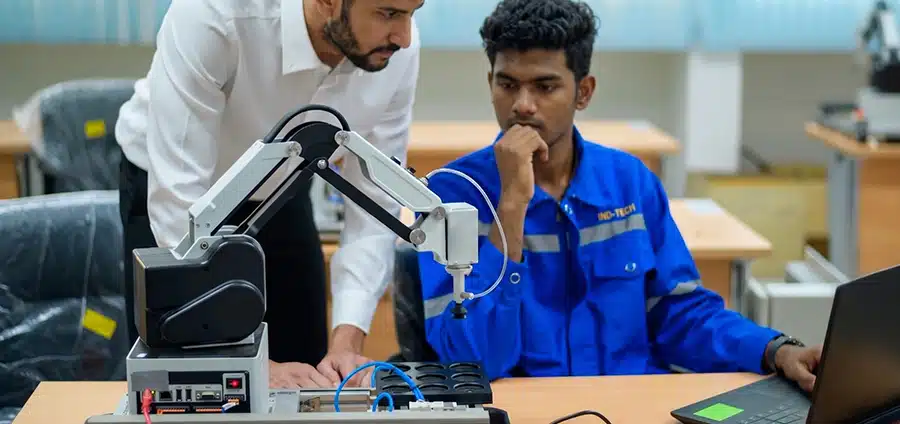
Engineering Students (2nd to 4th Year)

Recent Graduates Targeting Robotics Roles
Engineers within a year of graduation who want to break into robotics, AMR, drone engineering, or autonomous systems. The hands-on portfolio is the conversion lever that resumes alone cannot provide.

Working Professionals Career-Switching
Embedded engineers, IT professionals, or hardware technicians transitioning into robotics or UAV roles. The course's 1.5-hour daily rhythm is compatible with full-time employment.
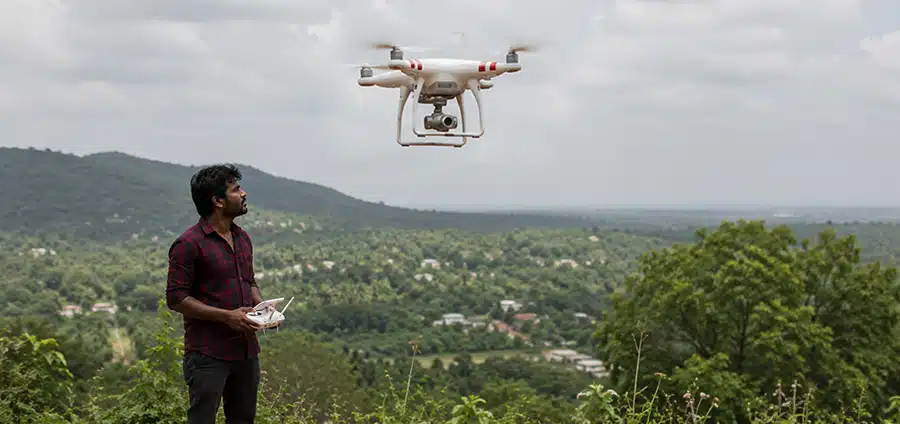
Aspiring Drone Pilots and Operators
Learners targeting a DGCA Remote Pilot Certificate who want practical knowledge of the airframe, autopilot, and mission planning — not just the rulebook. Module 3 covers the engineering side of the same airspace that the DGCA exam covers from the regulatory side.

Deep-Tech Entrepreneurs
Founders or co-founders building physical products in agri-tech, defence-tech, EV mobility, logistics, or industrial automation. Knowing how to prototype a robot or drone in 45 days is the difference between a deck and a demo.

Faculty and Lab Coordinators
College faculty who want to upgrade their robotics lab capability and learn the modern tooling (ROS 2, ArduPilot, KiCad, Pixhawk) that their best students will demand.
Every feature below is built into the program — no upsells, no premium tiers.
| Feature | What You Actually Get |
|---|---|
| Live Projects | Three mini projects + one capstone, all on real hardware. No simulators-only learning. |
| Capstone Project | Track-aligned coordinated robot + drone mission, evaluated by an external industry panel. |
| Hardware Kit | Personal access to robot chassis, motors, drivers, sensors, Raspberry Pi 4. Quadcopter and LiDAR shared across small teams. |
| Real Drone Flights | Tethered hover plus supervised outdoor autonomous missions under DGCA-compliant safety protocols. |
| ROS 2 Humble Stack | Production-grade middleware used by global AMR and agri-robot companies. |
| DGCA Safety Briefing | Mandatory pre-flight safety module aligned to Drone Rules 2021 and Drone Shakti norms. |
| Certification | Embedron Robotics & Drones Certificate (verifiable QR + transcript) on successful completion. |
| Internship Routing | Top 20% of learners are auto-routed to robotics integration internships through the Talent Portal. |
| Placement Support | Resume reviews, GitHub polish workshops, mock interviews, LinkedIn Featured-section coaching. |
| LMS Access | Lifetime access to recorded sessions, lab manuals, datasheets, and component reference guides. |
| Downloadable Resources | Schematics, BOMs, KiCad project files, URDF templates, ROS launch files, ArduPilot configs. |
| Industry Mentorship | At least one guest mentor per module — practising engineers from Indian product and EMS companies. |
| Interview Preparation | Embedded systems mock interviews and aptitude rounds in the final week. |
| Community Access | Private Discord/Slack with current cohort, alumni network, and rotating Q&A office hours. |
| DFM and PCB Thinking | Designs are reviewed for manufacturability — not just for working on a breadboard. |
| Safety-First Culture | ESD discipline, propeller guards, tether protocols, LiPo handling, and fire-readiness drills. |

Current Market Demand

Global Opportunities

Freelancing Opportunities
Job Roles You Can Target
| Role | Indicative Starting CTC (LPA) | Best-Fit Track |
|---|---|---|
| Robotics Integration Engineer | 5 – 9 | Manufacturing |
| Junior Drone Engineer | 4 – 8 | Defence / Agriculture |
| UAV Pilot + Operator | 4 – 7 | Any |
| AMR Firmware Engineer | 6 – 12 | Manufacturing |
| Field Robotics Technician | 3.5 – 6 | Agriculture |
| Embedded Robotics Intern → FTE | Stipend → 5–8 | Any |
| Computer Vision Engineer (Robotics) | 7 – 14 | Transport / Defence |
| ROS 2 Application Engineer | 6 – 12 | Manufacturing |
| Drone Mission Planner / Operations | 5 – 9 | Agriculture |
| Hardware-in-the-Loop (HIL) Engineer | 6 – 11 | Defence / Transport |
| Robotics R&D Trainee at DRDO/ISRO labs | Stipend → research | Defence |
| Agri-Drone Product Engineer | 5 – 10 | Agriculture |
| Mobility Robotics Engineer (EV) | 6 – 12 | Transport |
| Autonomous Vehicle Systems Intern | Stipend | Transport |
| Deep-Tech Founder / Co-Founder | Variable | Any (capstone-led) |
| Robotics Lab Coordinator (Academic) | 4 – 7 | Any |
| Drone Surveying & Mapping Engineer | 5 – 9 | Transport / Agri |
| Solar/Wind Inspection Drone Engineer | 5 – 10 | Manufacturing |
| Industrial Inspection Drone Operator | 4 – 8 | Manufacturing |
| BVLOS Operations Specialist | 6 – 12 | Defence |
Hiring Industries
- Drone OEMs and Operators — ideaForge, Garuda Aerospace, ASTERIA Aerospace, Marut Drones, Skye Air, IoTechWorld
- Warehouse and Logistics Robotics — GreyOrange, Addverb, Locus Robotics India, FreshBus, Delhivery automation
- Agri-Tech Robotics — Fasal, CropIn, Niqo Robotics, AgNext, Stellapps (collar robotics)
- Defence and Aerospace — DRDO labs, BEL, BDL, HAL, Tata Advanced Systems, L&T Defence, iDEX startups
- EV and Automotive — Ola Electric, Ather Energy, Mahindra Electric, Tata Motors EV, Bosch India, Mahindra Research
- Industrial Automation — Siemens India, ABB India, Schneider Electric, Yokogawa, Honeywell
- Service Robotics — Invento Robotics, Asimov Robotics, Miko, robotics arms of hospitality and healthcare brands
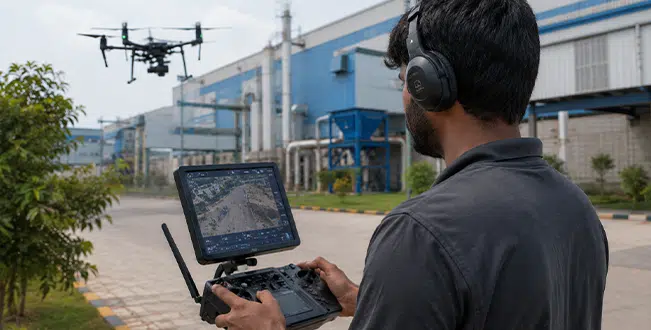
Career Pathway
Stage 1: Beginner (0–6 months)
Entry roles: Robotics Integration Trainee, Junior Drone Engineer, Embedded Robotics Intern, Field Robotics Technician. Expected CTC band: 3.5–6 LPA. Focus: closing the gap between portfolio projects and production codebases, getting comfortable with versioned ROS 2 packages, and building flight hours under supervision if pursuing drones.
Stage 2: Intermediate (1–3 years)
Roles: Robotics Engineer, UAV Engineer, AMR Firmware Engineer, ROS 2 Application Engineer. Expected CTC band: 6–12 LPA. Focus: leading small modules in larger systems, mastering Nav2 customisation, contributing to in-house drone autopilot stacks, and starting to mentor newer engineers.
Stage 3: Advanced (3–6 years)
Roles: Senior Robotics Engineer, Drone Product Architect, Robotics Team Lead, Autonomous Systems Engineer. Expected CTC band: 12–25 LPA. Focus: end-to-end ownership of robot platforms, BVLOS mission design, multi-robot coordination, and architecting the autonomy stack for new product lines.
Stage 4: Expert (6+ years)
Roles: Principal Engineer, Engineering Manager, VP of Robotics, Founder. Expected CTC band: 25 LPA and above, often with equity in product companies. Focus: technical strategy, IP creation, regulatory engagement (especially with DGCA, MoCA, and the BIS/IEC committees), and shaping the next generation of Indian robotics talent.
Lateral Transitions This Course Unlocks
- Embedded firmware → Robotics firmware (Module 1 + 3 combination is the cleanest bridge in the industry).
- Mechanical engineering → Mechatronics and robotics (the URDF and motion-control fundamentals translate directly).
- CSE/AI → Robotics software with ROS 2, computer vision, and SLAM (Module 3 fills the embedded gap).
- EV powertrain engineering → Drone propulsion and battery systems (BLDC + LiPo skills are interchangeable).
Future Roadmap
Advanced Certifications to Pursue After Module 3
- DGCA Remote Pilot Certificate (RPC) — mandatory for commercial drone operations in India.
- ARM Accredited Engineer — strengthens embedded firmware credibility.
- AWS Certified Cloud Practitioner + AWS RoboMaker familiarity — opens cloud-robotics roles.
- NVIDIA Jetson and Isaac SDK training — for advanced Edge AI robotics work.
- ISA Certified Automation Professional (CAP) — for industrial robotics overlap.
- Edge Impulse Certified Developer — for TinyML on robots and drones.
- PMI Project Management foundations — for engineers shifting into program-lead roles.
India-Specific Strategic Themes
- Drone Shakti Mission — 1 lakh certified pilots target by 2028 creates massive job pipeline.
- Make in India for Drones — PLI scheme is pushing local manufacturing, creating hardware engineer demand.
- Smart Cities 2.0 — municipal robotics for waste, water, traffic creating new vertical markets.
- Defence indigenisation — iDEX, DRDO, and BEL contracts increasingly favour Indian-built autonomous systems.
- Agri-credit-linked drone services — Drone Didi and Namo Drone Didi schemes creating new operator categories.
Higher Education Pathways
Emerging Technologies on the Horizon
| Technology | Why It Matters Next | When to Add to Your Skill Stack |
|---|---|---|
| NVIDIA Jetson Orin / Isaac | GPU-accelerated SLAM and perception on robots | Within 6 months of completion |
| RTK GPS and PPK workflows | Centimetre-grade drone positioning for surveying | Once you have DGCA RPC |
| UWB indoor localisation | Centimetre-grade indoor positioning for warehouses | When chasing AMR roles |
| BVLOS operations | Beyond Visual Line of Sight commercial drone work | Year 2 of your drone career |
| Multi-agent fleet coordination | Warehouse + agriculture multi-robot deployments | Year 2–3 |
| Post-quantum cryptography for OT | Secure communications for defence robotics | Long-term, especially defence track |
| VTOL fixed-wing hybrid drones | Long-range agriculture and survey applications | Year 2 onwards |
| Spiking neural networks on neuromorphic chips | Sub-microwatt edge intelligence on robots | Research-track learners |
Detailed Syllabus (Week-by-Week)
Week 1 — Robotics Foundations & Kinematics
| Day | Topic | Hands-On Lab |
|---|---|---|
| 91 | Robot classes, DOF, kinematics intro | Disassemble and reassemble a chassis |
| 92 | DC motors, encoders, gearboxes | Read RPM from a JGB37-520 motor |
| 93 | Motor drivers — L298N, BTS7960, TB6612FNG | Drive a chassis forward, back, turn |
| 94 | Differential drive kinematics | Teleoperated keyboard control over BLE/UART |
| 95 | Closed-loop PID speed control | Tune PID against load disturbance |
| 96 | Power, BEC, harness discipline | Build a clean harness, thermal soak under load |
Week 2 — Sensors for Robots
| Day | Topic | Hands-On Lab |
|---|---|---|
| 97 | IMU sensor fusion — Madgwick, Mahony | Stable tilt and heading from MPU9250 |
| 98 | Ultrasonic array, obstacle vector | Five-sensor collision avoidance |
| 99 | IR line sensors + PID following | Smooth PID curve-following robot |
| 100 | VL53L1X ToF sensors | Wall-follower more accurate than ultrasonic |
| 101 | RPLiDAR A1 setup | View live scan in RViz from the Pi |
| 102 | Camera basics + OpenCV intro | Detect a red ball position from USB cam |
Week 3 — ROS 2 Humble: The Robotics OS
| Day | Topic | Hands-On Lab |
|---|---|---|
| 103 | ROS 2 architecture, DDS, nodes, topics | Install Humble, ros2 doctor, turtlesim |
| 104 | Python nodes with rclpy | Sensor publisher from Pi GPIO |
| 105 | C++ nodes with rclcpp | Port the Python publisher, compare CPU |
| 106 | Launch files and parameters | Single ros2 launch command brings up robot |
| 107 | TF2 — transform trees | Build base_link → wheels → laser TF tree |
| 108 | URDF and robot description | Author robot URDF, visualise in RViz |
Week 4 — SLAM, Navigation & Autonomy
| Day | Topic | Hands-On Lab |
|---|---|---|
| 109 | Odometry from encoders + IMU | Square-drive drift measurement |
| 110 | 2D SLAM with slam_toolbox | Live map of the lab in RViz |
| 111 | Map saving and reuse | Save the map, reload after restart |
| 112 | Localisation with AMCL | Localise after random startup |
| 113 | Nav2 stack — path planning | Set 2D goal in RViz, watch robot plan |
| 114 | Behaviour trees & mission logic | Multi-waypoint patrol with recovery |
Week 5 — Drone Anatomy & First Flight
| Day | Topic | Hands-On Lab |
|---|---|---|
| 115 | Multirotor aerodynamics, frame geometries | Identify F450 components on the bench |
| 116 | Brushless motors, ESCs, KV rating | Thrust stand bench-test, build thrust curve |
| 117 | Pixhawk vs F4 stack flight controllers | Wire Pixhawk Mini, Mission Planner connect |
| 118 | Receivers, TX, telemetry — SBUS | Bind FlySky FS-i6, verify all channels |
| 119 | Calibration — accel, compass, ESC, radio | Full calibration sequence end-to-end |
| 120 | First hover — DGCA safety, kill-switch | Tethered first hover in the safety cage |
Week 6 — Autonomous Drone Programming
| Day | Topic | Hands-On Lab |
|---|---|---|
| 121 | ArduPilot SITL simulation | Auto mission in Mission Planner SITL |
| 122 | MAVLink protocol deep dive | pymavlink: read attitude, send ARM |
| 123 | DroneKit-Python missions | Upload + execute 4-waypoint mission in SITL |
| 124 | GPS, geofencing, failsafes | Configure RTL, geofence, battery failsafe |
| 125 | Companion computer with MAVProxy | Pi-aboard mock setup, stream telemetry |
| 126 | Real flight — autonomous mission | First outdoor autonomous square mission |
Week 7 — Mini Projects
Week 8 — Capstone Build, Demo & Career Launch
Robotics Foundations & Motion Control
Primary keyword: hands-on robotics motion control course
Topics Covered
• Quadrature encoders and RPM measurement using interrupts
• Motor drivers — L298N, BTS7960, TB6612FNG selection criteria
• Differential drive kinematics — wheel velocity to body velocity transformations
• PID control theory and practical tuning techniques
• Power supply design for robots — battery sizing, BEC, common-ground discipline
Practical Exercises
• Build a clean wiring harness for a 4-wheel chassis with fuse protection
• Tune PID against a load disturbance to meet a 5% overshoot, sub-500 ms settling spec
Mini Project Idea
Learning Outcome
Sensors, Vision & Perception
Primary keyword: robot perception and computer vision training
Topics Covered
• Ultrasonic and IR ranging sensors — strengths, weaknesses, fusion patterns
• Time-of-flight sensors (VL53L1X) for precise wall-following
• 2D LiDAR (RPLiDAR A1) and scan interpretation in RViz
• Camera basics — V4L2, USB cameras, MIPI CSI cameras
• OpenCV essentials — blob detection, ArUco markers, lane detection
Practical Exercises
• Use a USB webcam to track a red ball and command the robot to follow it
• Detect ArUco markers and trigger different robot behaviours per marker ID
Mini Project Idea
ROS 2 Humble Hands-On
Primary keyword: ROS 2 Humble robotics course India
Topics Covered
• rclpy and rclcpp — writing nodes in Python and C++
• Launch files, parameter YAML, namespaces, and composable nodes
• TF2 transform trees and the importance of consistent coordinate frames
• URDF authoring with proper inertial properties and meshes
• RViz2 for live visualisation of robot state and sensor data
Practical Exercises
• Author a full URDF for the four-wheel chassis with proper joint definitions
• Bring up the entire robot stack with one ros2 launch command from a YAML config
Mini Project Idea
SLAM, Navigation & Autonomy
Primary keyword: SLAM and Nav2 robotics tutorial
Topics Covered
• Odometry from encoder + IMU sensor fusion using robot_localization
• 2D SLAM with slam_toolbox — live mapping, loop closure, persistence
• Map saving, loading, and multi-floor strategies
• AMCL localisation — particle filters, initial pose, divergence recovery
• Nav2 stack — global planners, local planners, recovery behaviours
• Behaviour trees vs FSMs for mission orchestration
Practical Exercises
• Generate a live occupancy grid of the lab using slam_toolbox in real time
• Set a 2D goal in RViz and watch Nav2 plan a path around obstacles
Mini Project Idea
Drone Build, Calibration & First Flight
Primary keyword: F450 quadcopter build and Pixhawk calibration course
Topics Covered
• Brushless DC motors — KV rating, prop pitch, thrust-to-weight ratio
• Electronic Speed Controllers — current rating, BLHeli vs OneShot
• Pixhawk flight controller architecture and sensor suite
• Receivers, transmitters, SBUS, and telemetry radios
• Calibration sequence — accelerometer, compass, ESC, radio
• DGCA Drone Rules 2021, safety protocols, pre-flight checklist
Practical Exercises
• Wire a Pixhawk Mini end-to-end and connect to Mission Planner
• Complete the full calibration sequence and a tethered first hover
Mini Project Idea
Autonomous Missions, MAVLink & Capstone
Primary : autonomous drone mission programming with ArduPilot
Topics Covered
• MAVLink protocol — message catalogue, ACKs, request streams
• pymavlink and DroneKit-Python for programmatic drone control
• Mission planning — waypoints, geofences, RTL altitude, failsafes
• Companion computer pairing — Raspberry Pi with MAVProxy bridge
• Outdoor flight safety, supervised mission execution, post-flight analysis
Practical Exercises
• Write a Python script that arms the drone, takes off to 5 m, and lands — entirely in SITL
• Plan and execute a real outdoor autonomous mission under instructor supervision
Capstone Project
Industry Application
Module-wise Sub-Documents
For deeper content marketing and SEO siloing, Module 3 is split into six sub-documents, each one a standalone landing-page or blog hub. Each sub-doc carries its own primary keyword, internal CTA, and rich content. Together they form a topical cluster that strengthens the parent landing page's authority.
Curriculum Framework
Learning Stages
| Stage | Days | Primary Skill | Anchor Outcome |
|---|---|---|---|
| Foundation | 91–96 | Motion control & PID | PID-tuned mobile robot |
| Perception | 97–102 | Sensors & vision | Multi-sensor obstacle-avoidance robot |
| Middleware | 103–108 | ROS 2 Humble | Live URDF-driven RViz visualisation |
| Autonomy | 109–114 | SLAM & Nav2 | Autonomous waypoint mission |
| Aerial Build | 115–120 | Drone assembly + calibration | Tethered first hover |
| Aerial Autonomy | 121–126 | MAVLink + missions | Outdoor autonomous mission |
| Projects | 127–132 | Mini projects (×3) | Three GitHub-ready deliverables |
| Capstone | 133–135 | Integration + demo | Robot + drone demo day |
Practical vs Theory Breakdown
Project-Based Learning Structure
Pass Criteria
• Minimum 80% attendance with documented exceptions
• Logbook signed off by the trainer at the end of every week
• GitHub portfolio containing all mini projects + the capstone with READMEs
• Cleared drone pre-flight safety quiz with at least 80% score
Learning Stages
| Component | Weight | Description |
|---|---|---|
| Practical lab assessment | 25% | Random experiment + on-spot debugging |
| Mini project reviews (×3) | 15% | Two design reviews + final demo per project |
| Capstone project | 30% | Build quality, integration, panel demo |
| Drone pre-flight safety quiz | 5% | DGCA-aligned safety knowledge check |
| Viva voce | 10% | Oral examination on concepts and debugging |
| Assignment & logbook | 10% | Daily journal + weekly assignments |
| Attendance & innovation | 5% | Minimum 80% + bonus features |