






Become an Industry 4.0 Engineer in 45 Days — PLC, Edge AI, Digital Twins & Capstone-Ready Skills

70% practical, hands-on labs with industry-grade hardware

Track-aligned capstone — Agriculture, Manufacturing, Defense or Transport

Industry panel evaluation on Demo Day

Mentorship from working PLC, IoT and Edge AI engineers

Placement support across 80+ hiring partners
Industry Demand Statement
Placement Support Statement
Program Highlights
Start Your Learning Journey With Confidence
- Course Overview
- Course Objective
- Learning Outcomes
- Target Audience
- Course Features
- Industry & Job Connect
Why This Course Exists
Most Industry 4.0 courses stop at PowerPoint slides. Embedron+ Module 4 is built to do the opposite — every concept you learn here gets your hands on a PLC, a sensor, a microcontroller running an AI model, or a real digital twin in the cloud. By the time you reach Day 180, you will have designed and demonstrated a complete cyber-physical system aligned to a real Indian industry.
Module 4 sits at the top of the Embedron+ stack. It assumes you have already mastered electronics fundamentals, embedded firmware and IoT communication in earlier modules. From there, it elevates your skills with industrial automation (PLC, SCADA, Modbus, OPC-UA), edge intelligence (TinyML, vision and audio AI), and Industry 4.0 architecture patterns (digital twins, predictive maintenance, OT cybersecurity).
Who This Course Is Designed For
This is the module that turns a competent embedded student into a placement-ready Industry 4.0 engineer. It is engineered for engineering students in their final year, junior firmware engineers stuck doing only Arduino-level work, working automation technicians upgrading toward smart manufacturing, and deep-tech founders who need a tangible prototype before their seed round.
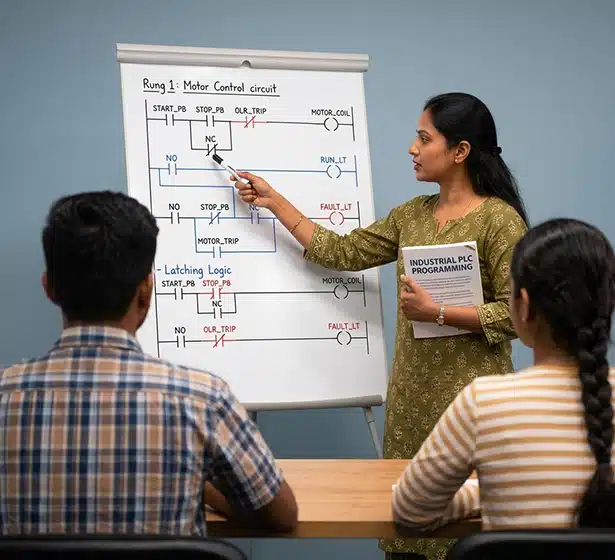
Industry Relevance
The Indian manufacturing sector is undergoing the largest automation upgrade in its history. Tata Motors is twinning every weld station. Bajaj Auto is rolling out PdM across plants. Ola Electric and Ather are building telematics into every EV. DRDO and BEL are testing edge-AI sentry nodes. Embedron+ Module 4 is reverse-engineered from these exact deployments so graduates step into roles that mirror what they already built in class.
From Beginner to Advanced — Where Module 4 Fits
Module 4 is the final stage of the Embedron+ learning journey. Module 1 teaches you to read a datasheet and blink an LED. Module 2 teaches you to push data to the cloud. Module 3 teaches you to control a robot or drone. Module 4 teaches you to deploy all of it inside a real industrial context — with the safety, security and reliability that production demands.
Real-World Use Cases You Will Build
- Greenhouse PLC controller with edge-AI plant-stress detection (Agriculture track)
- Conveyor predictive maintenance system with FFT vibration analytics (Manufacturing track)
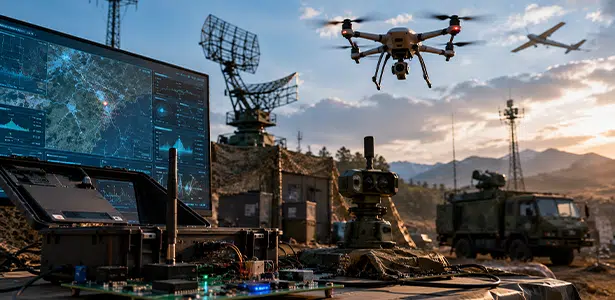
- Hardened edge AI sentry node with encrypted LoRa relay (Defense track)
- EV battery telematics + driver-behavior AI with cloud digital twin (Transport track)
By the end of Embedron+ Module 4, you will be able to:











Technical Skills You Will Master
- PLC programming in Ladder, Structured Text and Function Block Diagram on Delta DVP and Siemens S7-1200 hardware.
- SCADA system design with Ignition Maker Edition and FUXA — tags, drivers, historians, alarms and trends.
- Industrial communication using Modbus RTU/TCP, OPC-UA and a working introduction to PROFINET and EtherNet/IP.
- Edge AI workflows in TensorFlow Lite Micro and Edge Impulse — data collection, training, quantization and deployment.
- Vibration analytics with FFT, RMS and kurtosis on ADXL345 data streamed from ESP32 devices.
- Digital twin authoring in DTDL and deployment on Azure Digital Twins, with bidirectional sync to physical assets.
- Time-series telemetry pipelines on InfluxDB, Grafana, Node-RED and Mosquitto.
- OT cybersecurity per IEC 62443 — zoning, conduits, TLS 1.3 and signed OTA updates.
Practical Skills You Will Demonstrate





Industry & Portfolio Readiness



Embedron+ Module 4 is intentionally designed for learners who want to make the leap from prototype tinkering to deployable Industry 4.0 systems. You will get the most out of this module if you fit one of the profiles below.
| Audience | Background | Why This Course Is For Them |
|---|---|---|
| Final-Year Engineering Students | ECE, EEE, Mechatronics, CSE, AI&DS, IT | Want a placement-grade capstone and a portfolio that gets shortlisted. |
| Working Embedded Engineers | 0–3 years experience, mostly firmware on Arduino/STM32 | Want to break out of throwaway Arduino projects into real industrial systems. |
| Automation Technicians | ITI/Diploma background with PLC exposure | Want to upgrade with Industry 4.0, Edge AI and IIoT skills for higher-paying roles. |
| Career Switchers | From IT, software, mechanical or electrical roles | Want to enter the deep-tech, smart manufacturing or EV ecosystem. |
| Deep-Tech Founders | Pre-seed or seed-stage hardware startups | Need a working prototype, BOM and demo video for investor conversations. |
| Domain Engineers | Agriculture, defense, transport, manufacturing | Want to add a digital layer to existing physical workflows. |
| Faculty & Trainers | ECE / Mechatronics / Robotics professors | Want an Industry 4.0 curriculum to deliver to their own students. |
Prerequisites
- Successful completion of Embedron+ Modules 1, 2 and 3 — or equivalent industry experience verified by a short technical screening.
- Working knowledge of embedded C/C++ and at least one of Python or JavaScript.
- Basic familiarity with MQTT, HTTP and microcontroller programming on ESP32 or STM32.
- A laptop with at least 16 GB RAM, a clean USB workflow, and stable internet for cloud labs.
| Feature | What You Get |
|---|---|
| Hands-on Live Projects | Twenty graded labs across PLC, SCADA, Edge AI, PdM and Digital Twin clusters — every lab is graded and logged in your portfolio. |
| Capstone Project | Track-aligned, industry-panel-evaluated capstone integrating PLC + Edge AI + Cloud + Mobile. Worth 40% of module assessment. |
| Industry-Grade Hardware | Delta DVP / Siemens S7-1200 PLCs, ESP32-S3, OV2640 cameras, ADXL345 vibration sensors, real HMIs and energy meters. |
| Industry 4.0 Certification | Embedron Industry 4.0 Practitioner certificate with QR-verifiable digital credential and detailed transcript. |
| Internship Support | Dedicated internship dossier pushed to 80+ Indian hiring partners across manufacturing, EV, agri-tech and defense. |
| Placement Support | 1:6 mentor allocation, mock interviews, aptitude practice and a polished pitch video for every learner. |
| LMS & Lifetime Access | Lecture recordings, lab handbooks and slide decks accessible for life. Curriculum updates pushed quarterly. |
| Downloadable Resources | BOMs, schematic templates, DTDL models, Edge Impulse projects and PLC reference code — all yours to keep. |
| Industry Mentorship | Live mentor hours with working PLC, IoT and Edge AI engineers from Indian manufacturing and EV companies. |
| Interview Preparation | Embedded systems mock interview, aptitude rounds and HR practice in the final week. |
| Community Access | Private Discord community of Embedron+ alumni, mentors and recruiters for lifelong networking. |
| Industry Panel Demo Day | Live 12-minute capstone demo in front of a three-member external industry panel — and the recording stays in your portfolio. |

Current Market Demand

Global & Freelance Opportunities
Industries Actively Hiring Module 4 Graduates
| Sector | Representative Employers |
|---|---|
| Automotive & EV Manufacturing | Tata Motors, Mahindra, Bajaj Auto, Ola Electric, Ather, TVS, Ashok Leyland, Hero MotoCorp |
| Industrial Automation | Bosch, Siemens India, Delta Electronics, Yokogawa, Honeywell, ABB India, Rockwell Automation |
| Defense & Aerospace | DRDO, BEL, BDL, HAL, Tata Advanced Systems, L&T Defence, iDEX-funded startups |
| Agri-Tech & Food Processing | Stellapps, CropIn, DeHaat, Fasal, ITC ABD, Jain Irrigation, Mahindra Agri |
| EMS & Product Engineering | Tata Elxsi, Cyient, L&T Technology Services, HCL Technologies, Wipro PARI |
| Smart Energy & Utilities | Reliance Jio, Adani Green, Tata Power, Larsen & Toubro, Smart City missions |
| IIoT Platform & Startups | Ripik.AI, Detect Technologies, Flutura, Altizon, FogHorn, SeaSpire |
Job Roles You Become Eligible For
- Industrial Automation Engineer
- PLC / SCADA Engineer
- Industry 4.0 Solutions Engineer
- Edge AI Engineer
- TinyML Engineer
- Embedded Firmware Engineer
- Industrial IoT (IIoT) Developer
- Digital Twin Engineer
- Predictive Maintenance Engineer
- Smart Manufacturing Consultant
- EV Telematics Engineer
- Battery Management System (BMS) Engineer
- OT Cybersecurity Analyst
- Edge Computing Engineer
- Field Application Engineer (Automation)
- MES Integration Engineer
- Robotics Integration Engineer
- Smart Factory Architect (post-experience)
- Deep-Tech Startup Co-Founder
- Embedded Systems R&D Engineer
Indicative Salary Bands (Indian Market, Entry-Level)
| Role | Indicative CTC | Hiring Profile |
|---|---|---|
| Junior Embedded Engineer | ₹ 4 – 7 LPA | Tier-2 and Tier-3 EMS, product startups |
| IIoT Developer | ₹ 5 – 9 LPA | Industrial IoT platforms, agri-tech, smart-city startups |
| PLC / SCADA Engineer | ₹ 4 – 8 LPA | Manufacturing, EPC firms, plant integrators |
| Edge AI / TinyML Engineer | ₹ 8 – 14 LPA | Deep-tech startups, R&D labs, Tier-1 MNCs |
| BMS / EV Telematics Engineer | ₹ 6 – 12 LPA | Ola Electric, Ather, Mahindra EV, Tata Motors EV |
| Predictive Maintenance Engineer | ₹ 7 – 11 LPA | Reliance, Tata Steel, Bajaj Auto, large cement and pharma |
| Industry 4.0 Consultant | ₹ 9 – 16 LPA | Big-4 advisory, Cyient, LTTS, Tata Elxsi |
Career Pathway
Beginner → Intermediate → Advanced
| Stage | Typical Roles | Key Milestones |
|---|---|---|
| 0 – 1 yr (Entry) | Junior Embedded Engineer • PLC Trainee • IIoT Developer | Module 4 capstone + entry-level certifications (AWS Cloud Practitioner, Edge Impulse). |
| 1 – 3 yrs (Intermediate) | Industry 4.0 Solutions Engineer • Edge AI Engineer • SCADA Engineer | AZ-220, ISA CAP Associate, vendor-specific PLC certifications (Siemens, Rockwell). |
| 3 – 6 yrs (Senior) | Senior Automation Engineer • Smart Factory Architect • Edge AI Lead | Project leadership, multi-vendor systems, mentoring junior engineers. |
| 6 – 10 yrs (Principal) | Principal Industrial AI Engineer • Plant Digital Transformation Lead | Strategy ownership, P&L impact, cross-functional architecture. |
| 10+ yrs (Strategic) | Director of Smart Manufacturing • CTO of Deep-Tech Startup | Industry-wide influence, conference speaking, board-level technology decisions. |
Alternative Pathways
- Entrepreneurship — turn your Module 4 capstone into a deep-tech startup. Several Embedron+ alumni have raised pre-seed funding within 18 months of graduation.
- Higher Education — M.Tech in Embedded Systems, VLSI or Robotics at NITs, IIITs and top private universities. The capstone strengthens your Statement of Purpose substantially.
- Research — DRDO, ISRO, IISc and CSIR fellowships for graduates who pursue applied Industry 4.0 research.
- Global Mobility — MS programs abroad in Embedded Systems, Industrial AI or Robotics, with your capstone portfolio strengthening your application.
Future Learning Roadmap
Advanced Certifications to Pursue
| Certification | Strategic Value |
|---|---|
| AWS Certified IoT Specialty | Industrial IoT and cloud-scale telemetry workloads |
| Microsoft AZ-220 Azure IoT Developer | Azure Digital Twins, IoT Hub, Edge runtime |
| ISA Certified Automation Professional (CAP) | Senior automation engineer roles |
| Edge Impulse Certified Developer | Cutting-edge TinyML credibility |
| Siemens / Rockwell PLC Vendor Certifications | Plant-floor credibility with OEM equipment |
| DGCA Remote Pilot Certificate | Required if combining drones with Industry 4.0 work |
| CompTIA Security+ or GICSP | OT cybersecurity specialization |
Higher Learning Paths
- M.Tech in Embedded Systems / VLSI / Robotics / Industrial AI
- Specialized PG diplomas in Industry 4.0 (IISc, IITs, TalentSprint partnerships)
- Executive programs in Smart Manufacturing for engineers transitioning to management
- MS / PhD abroad with research focus in Industrial AI, Cyber-Physical Systems or Edge Computing
India-Specific Strategic Themes
- Semicon India Mission — design-skill alignment with the upcoming fab ecosystem in Gujarat, Karnataka and Tamil Nadu
- DGCA Drone Rules 2.0 — deeper coverage of beyond-visual-line-of-sight operations as regulations open up
- ONDC and UPI integration with IoT payment flows (EV charging, smart kiosks, vending automation)
- Smart Cities 2.0 — deeper municipal IoT deployment patterns in water, waste and lighting
- India AI Mission — integration of edge AI with sovereign foundation-model APIs
Emerging Technology Themes (12–24 Months)
- RISC-V based industrial microcontrollers (CH32V, ESP32-C6) for cost-sensitive IIoT designs
- Matter and Thread protocols crossing over from smart-home into industrial mesh networking
- 5G RedCap modems replacing NB-IoT in many low-power industrial scenarios
- On-device LLM agents and LangChain-style orchestration for industrial assistants
- Asset Administration Shell (AAS) — Industry 4.0's emerging standard for self-describing assets
- Post-Quantum Cryptography for long-lived OT deployments
- Spiking neural networks on neuromorphic microcontrollers for sub-microwatt inference
Detailed Syllabus — Week by Week
Week 1 — Industrial Automation Foundations & PLC Programming
| Day | Topic | Lab Activity |
|---|---|---|
| 136 | Industry 4.0 Overview, Automation Pyramid, Indian Context | Map field → PLC → SCADA → MES → ERP for a real factory case study. |
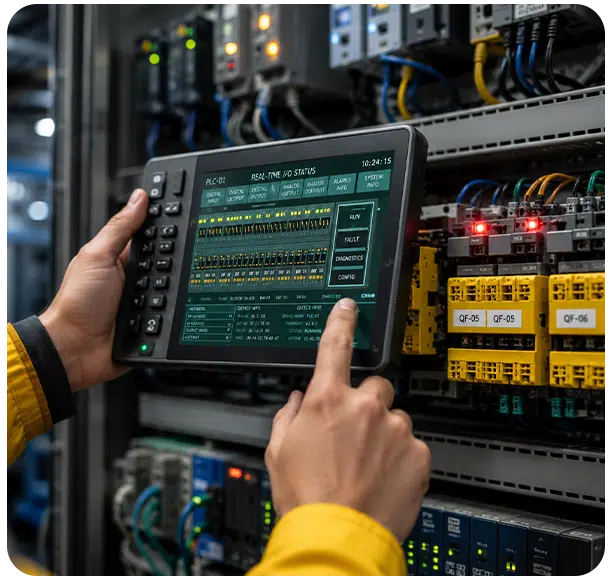
| 137 | PLC Architecture: CPU, I/O Modules, Power Supply, Scan Cycle | Tour and bring-up of Delta DVP / Siemens S7-1200 PLC. |
| 138 | Ladder Logic Fundamentals — Inputs, Outputs, Memory, Timers | Lab 4.1: Three-input motor start/stop with seal-in contact. |
| 139 | Timers, Counters, Comparators, Math Instructions | Lab 4.2: Traffic light controller with cyclic timer sequence. |
| 140 | Structured Text and Function Block Diagram | Lab 4.3: Tank level controller in ST with PID block. |
| 141 | Analog I/O, Scaling, Process Control Basics | Lab 4.4: 4–20 mA pressure sensor → PLC → scaled HMI display. |
| 142 | PLC Networking: Modbus RTU and TCP | Lab 4.5: Two PLCs exchange data over Modbus RTU (RS-485). |
Week 2 — SCADA, HMI & Industrial Communication
| Day | Topic | Lab Activity |
|---|---|---|
| 143 | SCADA Architecture: Tags, Drivers, Historians, Alarms | Set up Ignition Maker / FUXA connected to a PLC. |
| 144 | HMI Design Principles: ISA-101, Operator Workflows | Lab 4.6: HMI for a bottling line — start/stop/jog/alarms. |
| 145 | OPC-UA Theory: Information Model, Sessions, Subscriptions | Set up open62541 / OPC-UA test server, browse with UaExpert. |
| 146 | OPC-UA Hands-On: Bridging PLC and Edge Gateway | Lab 4.7: Raspberry Pi reads PLC via OPC-UA, pushes to MQTT. |
| 147 | Modbus TCP Deep Dive, Function Codes | Lab 4.8: ESP32 as Modbus TCP master polling a PLC. |
| 148 | Industrial Ethernet, PROFINET / EtherNet/IP Overview | Wireshark capture and analysis of industrial Ethernet frames. |
| 149 | Alarming, Trending, Historization in SCADA | Lab 4.9: Configure alarms + 30-day historian for a process variable. |
Week 3 — Edge AI Foundations & TinyML
| Day | Topic | Lab Activity |
|---|---|---|
| 150 | Edge AI vs Cloud AI, TinyML Use Cases, Constraints | Inventory MCU AI capability (ESP32-S3, RP2040, Nicla). |
| 151 | ML Recap: Features, Training, Inference, Quantization | Train a classifier in Python Colab; examine model size. |
| 152 | TensorFlow Lite Micro Architecture and Operators | Lab 4.10: Sine-wave inference on ESP32-S3. |
| 153 | Edge Impulse Platform Walkthrough | Lab 4.11: Motion classifier (idle / walk / shake) on IMU data. |
| 154 | Audio AI: MFCC Features, Keyword Spotting | Lab 4.12: 'Yes / No' keyword spotter on PDM microphone. |
| 155 | Vision AI on MCU: Person / Object Detection | Lab 4.13: ESP32-S3 + OV2640 person-detection demo. |
| 156 | Model Optimization: Quantization, Pruning, EON Compiler | Compress Edge Impulse model under 100 KB without losing accuracy. |
Week 4 — Predictive Maintenance & Sensor Fusion
| Day | Topic | Lab Activity |
|---|---|---|
| 157 | Predictive vs Preventive vs Reactive Maintenance | Case study: Indian textile mill PdM rollout. |
| 158 | Vibration Sensing: Accelerometers, FFT, RMS, Kurtosis | Lab 4.14: ADXL345 + ESP32 → FFT plot of motor vibration. |
| 159 | Anomaly Detection with Autoencoders / One-Class SVM | Lab 4.15: Edge Impulse anomaly model on motor vibration. |
| 160 | Current Signature Analysis, Thermal Imaging Basics | Capture motor current with ACS712; signature analysis. |
| 161 | Sensor Fusion: Vibration + Current + Temperature + Acoustic | Lab 4.16: Multi-sensor PdM node aggregating four streams. |
| 162 | Time-Series Cloud Pipelines: InfluxDB + Grafana | Lab 4.17: Push PdM telemetry to InfluxDB, dashboard in Grafana. |
| 163 | Alerting and Workflow Integration | Grafana alerts → WhatsApp / Telegram / Email. |
Week 5 — Digital Twins, Cloud Integration & Industry 4.0 Patterns
| Day | Topic | Lab Activity |
|---|---|---|
| 164 | Digital Twin Concept, ISO 23247, Twin Maturity Levels | Map the four 'twin types' onto your capstone vision. |
| 165 | Building a Digital Twin in Azure Digital Twins | Lab 4.18: DTDL model for a conveyor; ingest live telemetry. |
| 166 | Bidirectional Twin Sync — Commands Cloud → Device | Lab 4.19: Twin-driven setpoint change reflected on a PLC. |
| 167 | MES Concepts, OEE (Availability × Performance × Quality) | Compute OEE from a production-line dataset. |
| 168 | Cybersecurity for OT: IEC 62443, Air Gaps, DMZ | Audit a sample plant network; propose IEC 62443 zoning. |
| 169 | Sustainability & ESG: Energy Monitoring, Carbon Dashboards | Lab 4.20: Three-phase energy meter → kWh + CO₂ dashboard. |
| 170 | Industry 4.0 Reference Architectures (RAMI 4.0, IIRA) | Map your capstone idea onto RAMI 4.0 layers. |
Week 6 — Capstone Build, Demo & Career Launch
| Day | Topic | Activity |
|---|---|---|
| 171 | Capstone Kickoff — Track Selection & Project Charter | Submit one-page charter, BOM, milestone plan. |
| 172 | System Architecture Review & Risk Register | Architecture review with mentor; sign-off on PCB/firmware/cloud split. |
| 173 | Capstone Build Day 1 — Hardware Integration | Assemble PLC + sensors + edge AI node + comms backbone. |
| 174 | Capstone Build Day 2 — Firmware & Edge AI | Flash AI model; integrate with PLC over Modbus / OPC-UA. |
| 175 | Capstone Build Day 3 — Cloud, Twin & Mobile | Connect to cloud, build twin, deploy companion mobile app. |
| 176 | Capstone Build Day 4 — Integration & Field Test | End-to-end run; capture telemetry; iterate on issues. |
| 177 | Capstone Polish — Enclosure, Docs, Demo Video | Finalize enclosure, write 8-page report, record demo video. |
| 178 | Career Day 1 — Resume, GitHub, LinkedIn | Resume review; GitHub hygiene; LinkedIn portfolio post. |
| 179 | Career Day 2 — Mock Interviews & Aptitude | Embedded systems mock interview + aptitude round. |
| 180 | Capstone Demo Day — Industry Panel Evaluation | Live 12-minute demo + Q&A in front of industry panel. |
PLC Programming for Modern Industry
Overview
Topics Covered
• Ladder Logic: contacts, coils, seal-in, timers and counters
• Structured Text for PID, math operations and complex sequencing
• Function Block Diagram for signal chains and process control
• Analog I/O scaling for 4–20 mA and 0–10 V industrial sensors
• Modbus RTU networking between multiple PLCs
Practical Exercises
Industry Application
SCADA, HMI & Industrial Communication
Overview
Topics Covered
• HMI design per ISA-101 — operator-centric layouts and color discipline
• OPC-UA information modeling, sessions and subscriptions
• Modbus TCP function codes, polling strategies and master / slave roles
• PROFINET and EtherNet/IP overview with Wireshark traffic analysis
Practical Exercises
Edge AI & TinyML in Production
Overview
Topics Covered
• Edge Impulse Studio end-to-end workflow
• Audio AI with MFCC features and keyword spotting
• Vision AI on the ESP32-S3 with OV2640 camera
• Quantization, pruning and the EON Compiler for sub-100 KB models
Practical Exercises
Predictive Maintenance & Sensor Fusion
Overview
Topics Covered
• Current signature analysis and thermal imaging basics
• Autoencoder and one-class SVM anomaly detection
• Multi-sensor fusion pipelines combining vibration, current and temperature
• Time-series storage in InfluxDB and visualization in Grafana
• Alert routing to WhatsApp, Telegram and email
Digital Twins & Industry 4.0 Patterns
Overview
Topics Covered
• DTDL authoring and Azure Digital Twins ingestion
• Bidirectional twin commands flowing back to physical PLCs
• OEE computation from live plant data
• IEC 62443 zoning, conduits, TLS 1.3 and signed OTA
• Three-phase energy monitoring and CO₂ dashboarding for ESG
• RAMI 4.0 and IIRA reference architectures
Capstone Engineering & Career Launch
Overview
Deliverables
• Eight-page capstone report with architecture diagrams and BOM
• 60-second pitch video recorded under pro lighting
• Public GitHub repository with README, schematics and demo footage
• Resume reviewed by industry mentors
• Industry-panel evaluation on Demo Day
Module-Wise Sub-Documents
The detailed syllabus above breaks naturally into six self-contained sub-modules, each suitable for its own landing-page section, lead-magnet PDF or short-course offering. The structure below should be replicated on individual CMS pages with anchor links from the main Module 4 page.
Curriculum Framework
Learning Stages
| Stage | Days | Focus |
|---|---|---|
| Stage 1 — Foundations Refresh | Days 136–139 | Refresh embedded fundamentals; bridge to industrial context. |
| Stage 2 — Industrial Skills Build | Days 140–149 | PLC, SCADA, OPC-UA, Modbus — core OT competency. |
| Stage 3 — Edge Intelligence | Days 150–156 | TinyML, vision and audio AI on microcontrollers. |
| Stage 4 — Industrial AI Integration | Days 157–163 | Predictive maintenance with sensor fusion and anomaly detection. |
| Stage 5 — Industry 4.0 Architecture | Days 164–170 | Digital twins, OT cybersecurity, sustainability dashboards. |
| Stage 6 — Capstone & Career | Days 171–180 | End-to-end build, demo and placement preparation. |
Theory vs Practical Balance
| Activity | Duration | Description |
|---|---|---|
| Daily Concept Block | 27 min | Focused theory delivery on slides and whiteboard |
| Hands-on Lab Block | 45 min | Real hardware, real code, real debugging |
| Recap, Debrief & Viva | 18 min | Cross-group sharing and rapid-fire Q&A |
| Module Total Theory | 20.25 hours | 30% of contact hours |
| Module Total Practical | 47.25 hours | 70% of contact hours |
Assessment Structure
| Component | Weight | Description |
|---|---|---|
| Daily Lab Logs | 10% | Signed daily reports; portfolio artifacts |
| Weekly Vivas | 10% | Oral examination on concepts and debugging scenarios |
| Mid-Module Quiz | 10% | Multi-choice + code-reading test |
| Mini Projects | 20% | Track-aligned project deliverables across the module |
| Capstone Project | 40% | External industry panel evaluation on Demo Day |
| Attendance & Conduct | 10% | Minimum 80% attendance required |
Project-Based Learning Structure
- Daily Lab Layer — small, focused build that locks in one concept (e.g., Modbus RTU exchange)
- Cluster Lab Layer — multi-day build that integrates a week's worth of concepts (e.g., full HMI for a bottling line)
- Capstone Layer — full end-to-end Industry 4.0 system aligned to your chosen industry track