






Build Real Projects with Foundations of Embedded Systems & Electronics

70% Practical, 30% Theory - Counters fear of dry lecture-only training

Live Hardware Kit Included - Tangible value, removes objection

GitHub Portfolio After Each Module - Career credibility for recruiters

Industry Track Specialisation - Personalised relevance

Mentor Reviews on Every Project - Personal attention reassurance
Build Real-World Embedded Skills from Basics to Industry Projects.
Foundations of Embedded Systems & Electronics Course Highlights
- Course Overview
- Course Objectives
- Learning Outcomes
- Who Should Enroll
- Course Features
- Industry & Job Connect
Why This Course Matters
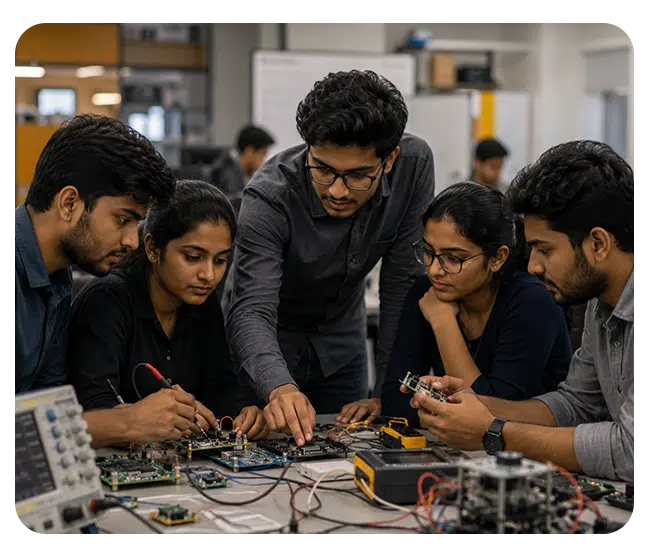
Three things separate someone who knows about embedded systems from someone who can engineer them. First, the fluency to read a datasheet without panic. Second, the muscle memory of wiring, flashing, and debugging real hardware over hundreds of hours. Third, the product-thinking to take an idea from breadboard to enclosed device. Most degree programs teach none of these. Embedron Module 1 teaches all three, simultaneously, every single day.
What Makes Module 1 Different
- 70:30 practical to theory ratio. Theory is delivered as a 15-minute briefing right before the lab needs it - never as a 90-minute monologue.
- Industry-track lens. The same syllabus is taught to every cohort, but mini projects and capstones specialise into Agriculture, Manufacturing, Defense, or Transport based on your chosen track.
- Failure-driven mastery. Trainers deliberately seed common mistakes - floating pins, wrong baud rates, missing pull-ups - so you experience and resolve real failure modes that no textbook can teach.
- Iterative build cycles. You will live through the full product cycle of Define → Breadboard → Prototype → PCB → Deploy, in one module.
- Public demo culture. Every capstone ends with a live demo to an external panel - exactly the muscle you need for placement interviews and client pitches.
Real-World Use Cases You Will Build Toward
By the time you finish Module 1, the projects on your bench will not be toy examples. They will be field-deployable units - a soil-and-air monitoring node a small farm could actually clip to a pole, a motor-health diagnostic puck a factory technician could clamp onto a pump, a perimeter PIR logger a security team could mount overnight. The depth comes from doing this work for 67.5 contact hours, with a mentor sitting next to you.












Technical Skills You Will Walk Away With
- Fluent embedded C and Arduino C++ programming across three MCU families.
- Hands-on experience with 12+ industry-standard sensors and 6+ actuator types.
- Complete proficiency in I2C, SPI, UART, and 1-Wire communication protocols.
- End-to-end PCB design workflow in KiCAD - schematic, footprint, layout, Gerber.
- Real instrumentation skills with multimeter, oscilloscope, and logic analyzer.
- Power supply design including linear regulators, buck converters, and battery management.
- Soldering and reflow skills for both through-hole and SMD components.
- Datasheet literacy across MCU, sensor, regulator, and discrete component documentation.
Practical Capabilities
- Build a working sensor node on perfboard from scratch in under three hours.
- Debug a non-working circuit in under thirty minutes using systematic methods.
- Design and order a 2-layer PCB suitable for small-batch manufacturing in India.
- Implement low-power design techniques for battery operation up to one week.
- Author firmware with watchdog protection, crash recovery, and EEPROM-backed configuration.
- Integrate three or more sensors on different buses in a single embedded product.
- Apply MISRA-C-aware coding discipline that scales to industry codebases.
Embedron Module 1 is designed as the on-ramp for anyone serious about building hardware-software products in India's deep-tech economy. It is not a beginner course in the absolute sense - you should be comfortable with basic C and know what a breadboard looks like - but it does not assume any industry experience.
| Profile | Why Embedron Module 1 Fits |
|---|---|
| B.E./B.Tech ECE / EEE Students (2nd–4th year) | Bridges the gap between academic syllabus and what recruiters actually expect at interviews and assessment days. |
| CSE / IT Students Curious About Hardware | Lets software learners cross into firmware, IoT, and robotics - three of the highest-paying entry-level tracks. |
| Mechanical / Mechatronics Students | Builds the electronics fluency required for robotics, drones, and automation roles that pure mech grads often miss. |
| Working Professionals (1–3 years) | Refresher for QA / test / production engineers who want to transition into embedded design or product engineering. |
| Final-Year Students Planning a Startup | Provides the breadboard-to-PCB-to-deployment muscle needed to build an MVP without outsourcing. |
| Career Switchers from Pure Software | Structured ramp into hardware with simulation safety nets and mentor reviews on every project. |
| Diploma / Polytechnic Graduates | Levels the playing field with engineering grads on practical hardware skills. |
Pre-requisites (Minimum)
- Basic C programming familiarity - loops, conditionals, functions, structs.
- School-level physics - Ohm's law, basic circuits, AC vs DC concepts.
- Comfort with a Windows, macOS, or Linux laptop for software installation.
- A genuine willingness to break things, debug, and try again.
| Feature | What It Means For You |
|---|---|
| Live Hardware Kit Provided | A complete personal kit including Arduino UNO, ESP32, STM32 BluePill, sensors, actuators, and tools - yours to keep. |
| 30+ Professional Labs | Every lab follows industry format: objective, theory, procedure, troubleshooting, viva, real-world application. |
| 3 Industry-Track Mini Projects | Specialised work in Agriculture, Manufacturing, Defense, or Transport - not generic toy projects. |
| Capstone Project per Module | Four portfolio-grade builds across the program; Module 1 produces your Smart Multi-Sensor Node. |
| Foundations Certificate | Digitally verifiable Elysium Embedded School certificate with QR-coded transcript. |
| GitHub Portfolio Building | Every project committed to your public repository under mentor review. |
| Mentor Office Hours | Twice-weekly small-group debugging sessions with industry-trained anchors. |
| Industry Guest Speaker | One real practitioner from the field walks the cohort through current problems. |
| Internship Track Activation | Junior internship eligibility unlocked at module completion. |
| Lifetime LMS Access | All recordings, lab manuals, and resources stay accessible after the cohort closes. |
| Peer Community Access | Slack / Discord channel with current cohort and alumni for ongoing help. |
| Demo Day Panel Review | External faculty and industry mentors review your capstone - interview-grade practice. |
Current Market Demand
Hiring Industries
- Automotive Electronics & EV (Tata Motors, Mahindra Electric, Ola Electric, Ather, Bajaj Auto, TVS)
- Industrial Automation (Bosch, Siemens India, ABB, Schneider, Larsen & Toubro)
- Consumer IoT & Wearables (Boat, Noise, Cult.fit, Stellapps for cattle-tech)
- Defense & Aerospace (DRDO labs, BEL, BDL, HAL, Tata Advanced Systems)
- Agri-Tech & Smart Farming (CropIn, Fasal, DeHaat, ITC ABD, Jain Irrigation)
- Engineering Services & R&D (Tata Elxsi, Wipro, HCL, Cyient, KPIT, L&T Technology Services)
- Hardware Startups & Deep-Tech (Detect Technologies, Log9 Materials, Cron AI, AgNext)
- Semiconductors & EDA (Synopsys, Cadence, Mentor Graphics, ARM India)
- Telecom & Networking (Reliance Jio platforms, Tejas Networks, HFCL)
- Smart City & Energy Management (Honeywell India, Siemens Mobility, Schneider Electric)
Entry-Level Job Roles Module 1 Unlocks
| Job Role | Typical Starting CTC (INR LPA) | Why Module 1 Helps |
|---|---|---|
| Junior Embedded Engineer | 3.5 - 6 | Direct match - hardware bring-up, firmware, debugging |
| Hardware Testing Intern / Engineer | 2.5 - 5 | Multimeter, oscilloscope, logic analyzer fluency |
| PCB Design Trainee | 3 - 5.5 | KiCAD project portfolio demonstrated |
| Firmware Trainee | 3.5 - 6 | Arduino, ESP32, STM32 production code |
| Production / Manufacturing Engineer (Electronics) | 3 - 5 | Soldering, reflow, AOI, bring-up experience |
| IoT Hardware Intern | Stipend ₹15-25k | Sensor interfacing, communication protocols |
| Robotics Trainee | 4 - 7 | Motor and sensor control foundations |
| EV Test Engineer | 4 - 6 | Power electronics fundamentals + battery awareness |
| Field Application Engineer (Sensors/MCUs) | 3.5 - 6 | Datasheet fluency + customer demo skills |
| Hardware Sales / Pre-Sales (Technical) | 4 - 7 | Engineering credibility for selling MCU/sensor lines |
Salary Insights
Global Opportunities
Career Pathway
Stage 1: Beginner (Module 1 - Where You Are)
Stage 2: Intermediate (Module 2 - IoT & Cloud)
Stage 3: Specialised (Module 3 - Robotics & Drones)
Stage 4: Industry 4.0 Ready (Module 4 - Automation & AI)
Role Transition Map
| Year 0 (Graduation) | Year 2 | Year 5 | Year 8+ |
|---|---|---|---|
| Junior Embedded Engineer | Embedded Engineer | Senior Firmware Engineer | Embedded Systems Architect |
| Hardware Testing Engineer | Hardware Design Engineer | Senior Hardware Engineer | Hardware Architect / Tech Lead |
| IoT Developer | IoT Solutions Engineer | IoT Platform Architect | Director of Engineering - IoT |
| Robotics Trainee | Robotics Engineer | Robotics Systems Engineer | Robotics R&D Manager |
| EV Test Engineer | BMS Engineer | EV Powertrain Engineer | EV Engineering Manager |
Future Learning Roadmap
Industry Certifications to Pursue in Parallel
- ARM Accredited Engineer - for serious embedded firmware roles.
- AWS Certified Cloud Practitioner & AWS IoT Specialty - for cloud-IoT pipelines.
- Microsoft AZ-220 Azure IoT Developer Specialty - increasingly recognised.
- DGCA Remote Pilot Certificate - required for any commercial drone career in India.
- Edge Impulse Certified Developer - gaining strong recognition in TinyML hiring.
- ISA Certified Automation Professional (CAP) - gold standard for automation engineers.
Emerging Fields This Foundation Connects To
- RISC-V (CH32V, ESP32-C6) - open ISA gaining rapid adoption in cost-sensitive IoT.
- Matter / Thread - cross-vendor smart home standard.
- TinyML on neuromorphic MCUs - sub-microwatt edge intelligence.
- 5G RedCap modems - low-cost cellular IoT replacing NB-IoT.
- Post-Quantum Cryptography for IoT - rolling out from 2025 onward.
- Asset Administration Shell (AAS) - Industry 4.0 standard for self-describing assets.
Embedron Module Progression
| Next Step | What You Will Learn | Career Milestone |
|---|---|---|
| Module 2 - IoT & Cloud Integration | MQTT, Wi-Fi, BLE, LoRa, Raspberry Pi gateways, Flutter mobile apps | Internship-Ready |
| Module 3 - Robotics & Drones | ROS 2, mobile robots, quadcopter assembly, SLAM, MAVLink | Field-Engineer-Ready |
| Module 4 - Industry 4.0, AI & Capstone | PLCs, SCADA, OPC-UA, TinyML, digital twins | Placement-Ready |
Detailed Syllabus (Week-by-Week)
Week 1 - Electronics Refresher & Lab Setup (Days 1-6)
| Day | Topic | Practical Activity |
|---|---|---|
| 1 | Lab Safety & Multimeter Mastery | Voltage, current, resistance, continuity drills |
| 2 | Resistors, Capacitors, Inductors | RC low-pass filter on oscilloscope |
| 3 | Diodes & LEDs | Half-wave and full-wave rectifier with ripple measurement |
| 4 | Transistors as Switch & Amplifier | BC547 relay driver and common-emitter amplifier |
| 5 | Power Supplies & Regulation | 7805 linear + LM2596 buck bench comparison |
| 6 | Breadboarding & Soldering Workshop | Through-hole LED blinker + 0805 SMD reflow board |
Week 2 - Arduino Platform & Embedded C Essentials (Days 7–12)
| Day | Topic | Practical Activity |
|---|---|---|
| 7 | MCU Architecture 101 | Tour of ATmega328 internals on the UNO board |
| 8 | Arduino IDE & First Programs | Blink, serial print, button read |
| 9 | GPIO Deep Dive | 4-LED chaser, debounced button counter |
| 10 | Timers & PWM | PWM LED dimming, servo angle control |
| 11 | ADC & Analog Sensing | ADC & Analog Sensing |
| 12 | Interrupts | Frequency counter via external interrupt |
Week 3 - Communication Protocols (Days 13–18)
| Day | Topic | Practical Activity |
|---|---|---|
| 13 | UART / Serial Communication | Two Arduinos exchanging messages |
| 14 | I2C Protocol | DS3231 RTC + 0.96" OLED on same bus |
| 15 | SPI Protocol | SD card logging + ADXL345 reading |
| 16 | 1-Wire & Sensor Buses | Multi-DS18B20 temperature network on one pin |
| 17 | Mini Hackathon - Sensor Multiplexer | Combined I2C/SPI sensor node |
| 18 | Logic Analyzer Bus Decoding | Decode UART/I2C live traffic |
Week 4 - Sensors & Actuators Deep Dive (Days 19–24)
| Day | Topic | Practical Activity |
|---|---|---|
| 19 | Environmental Sensors | Mini weather station - DHT22 + BMP280 + OLED |
| 20 | Distance & Motion Sensors | Desktop obstacle alarm |
| 21 | IMU & MPU6050 | Tilt angle with complementary filter |
| 22 | Industrial Sensors (Track Specific) | Track-aligned transducer mini-build |
| 23 | DC & Servo Motors | L298N H-bridge motor control |
| 24 | Steppers & Relays | NEMA17 + A4988 + 230V appliance switching |
Week 5 - ESP32 & STM32 - Stepping Up (Days 25–30)
| Day | Topic | Practical Activity |
|---|---|---|
| 25 | ESP32 Introduction | Wi-Fi scan + simple webpage |
| 26 | ESP32 Peripherals | LEDC PWM + capacitive touch + deep-sleep |
| 27 | STM32 Introduction | BluePill blink + UART |
| 28 | STM32 GPIO & Timers | PWM + input capture frequency measurement |
| 29 | STM32 ADC & DMA | 4-channel DMA sampling, serial-plot result |
| 30 | Comparative Lab | Same blinker on Arduino, ESP32, STM32 |
Week 6 - PCB Design Fundamentals (Days 31–36)
| Day | Topic | Practical Activity |
|---|---|---|
| 31 | Schematic Design Principles | ESP32 + DHT22 + regulator + USB schematic |
| 32 | Component Footprints & Libraries | Map components, create one custom footprint |
| 33 | PCB Layout Basics | Component placement, routing, ground pour |
| 34 | DRC, Gerbers & Manufacturing | Run DRC, fix violations, export Gerbers |
| 35 | Assembly & Bring-up | Hand-assemble a pre-fabricated PCB |
| 36 | Common PCB Pitfalls | Audit a deliberately flawed design |
Week 7 - Industry-Track Mini Projects (Days 37–42)
| Days | Project | Skills Reinforced |
|---|---|---|
| 37-38 | Mini Project 1 - Industry-Specific Sensor Logger | Sensor read + display + EEPROM/SD logging |
| 39-40 | Mini Project 2 - Actuator Control with Safety | Actuator + control logic + protection circuits |
| 41-42 | Mini Project 3 - Multi-Sensor Protoboard Integration | Multi-bus integration on hand-soldered board |
Week 8 - Capstone Project & Evaluation (Days 43–45)
| Day | Activity |
|---|---|
| 43 | Hardware integration, full sensor stack on protoboard, firmware skeleton |
| 44 | PCB review, enclosure mounting, demo rehearsal, documentation |
| 45 | Final evaluation - live demo + viva + portfolio submission |
Sub-Section: Electronics Fundamentals (Week 1)
Overview
Topics Covered
- Multimeter mastery - voltage, current, resistance, and continuity
- Resistor color codes, RC time constants, capacitor selection
- Diode characterization, half-wave and full-wave rectification
- BJT and MOSFET switching, biasing, flyback diode practice
- Linear vs switching regulators - efficiency and thermal trade-offs
- Through-hole and SMD soldering with ESD discipline
Learning Outcome
Industry Application
Sub-Section: Arduino & Embedded C (Week 2)
Overview
Topics Covered
- Von Neumann vs Harvard architecture, AVR ATmega328 internals
- Sketch structure, setup/loop, serial monitor debugging
- GPIO modes, pull-ups, pull-downs, sourcing vs sinking
- Timers, prescalers, PWM duty cycle and frequency control
- ADC resolution, reference voltage, sampling theory
- Interrupts, ISR design, volatile keyword, atomic access
Learning Outcome
Industry Application
Sub-Section: Communication Protocols (Week 3)
Overview
Topics Covered
- UART framing, baud rates, full-duplex async communication
- I2C master-slave, addressing, ACK/NAK, pull-up sizing
- SPI full-duplex, MOSI/MISO/SCK/CS, clock modes 0–3
- 1-Wire protocol, ROM addressing, parasitic power, CRC
- Bus arbitration, address conflicts, mixed-bus design
- Logic analyzer protocol decoding and timing analysis
Learning Outcome
Industry Application
Sub-Section: Sensors & Actuators (Week 4)
Overview
Topics Covered
- Environmental sensors - DHT22, BMP280, accuracy vs cost
- Distance sensors - ultrasonic HC-SR04, IR, PIR, ToF basics
- Inertial measurement with MPU6050 and complementary filtering
- Industrial track-specific sensors - soil moisture, current, gas, GPS
- DC motor and servo control with H-bridges and PWM
- Stepper motors with A4988, half-step and full-step modes
- Opto-isolated relay control for 230V appliances
Learning Outcome
Sub-Section: ESP32 & STM32 (Week 5)
Overview
Topics Covered
- ESP32 dual-core architecture, Wi-Fi and Bluetooth radios, ESP-IDF
- ESP32 peripherals - LEDC, RMT, touch pins, deep-sleep
- ARM Cortex-M0/M3/M4 fundamentals and HAL vs LL programming
- STM32CubeIDE and CubeMX clock-tree configuration
- STM32 GPIO alternate functions, timer prescalers, PWM, capture
- Multi-channel ADC with DMA - circular and single conversion
- Comparative analysis of all three MCU families
Learning Outcome
Sub-Section: PCB Design (Week 6)
Overview
Topics Covered
- Schematic capture, net naming, hierarchical sheets, ERC
- Component footprints, package codes (0805, SOIC, QFN)
- Layer stack-up, trace width, current capacity, vias
- Design Rule Check, Gerber export, drill files, BOM, CPL
- Hand assembly and reflow bring-up procedure
- Audit of deliberately flawed designs to build engineering judgement
Learning Outcome
Sub-Section: Capstone Project
The Smart Multi-Sensor Node
Topics Covered
- Working hardware on perfboard with mechanical robustness
- Firmware with cooperative scheduler, power management, and crash recovery
- Multi-screen OLED UI with menu navigation
- SD card logging with timestamp integrity over 30+ minute runs
- Documentation - schematic, BOM, README, user guide
- Five-minute demo video uploaded to GitHub
- Live demo to an external panel of mentors and industry guests
Module Sub-Sections - Granular Page Documents
Each sub-section below is structured as a self-contained landing page block. Use these as supporting content pages, microcopy modules, or as expandable accordion sections on the main course page.
Curriculum Framework
Learning Stages
| Stage | Days | Focus | Outcome |
|---|---|---|---|
| Stage 1 - Foundations | 1-6 | Electronics literacy, lab safety, measurement | Confidence with instruments and passive circuits |
| Stage 2 - Programming | 7-12 | Arduino, embedded C, GPIO, timers, ADC | Fluent microcontroller programming |
| Stage 3 - Communication | 13-18 | UART, I2C, SPI, 1-Wire, logic analyzers | Bus fluency and protocol debugging |
| Stage 4 - Real-World I/O | 19-24 | Sensors and actuators across domains | Sensor calibration and actuator safety |
| Stage 5 - Advanced MCUs | 25-30 | ESP32 and STM32 with HAL and DMA | Multi-MCU selection capability |
| Stage 6 - PCB Design | 31-36 | KiCAD schematic and layout workflow | Manufacturing-ready PCB output |
| Stage 7 - Application | 37-42 | Track-specific mini projects | Three portfolio assets |
| Stage 8 - Capstone | 43-45 | Multi-sensor node integration and demo | Foundations Certificate |
Theory vs Practical Breakdown
| Component | Hours | Percentage |
|---|---|---|
| Practical Labs (30 experiments) | 35 | 52% |
| Mini Projects (3 builds) | 9 | 13% |
| Capstone Build | 4.5 | 7% |
| Theory Briefings (in-lab) | 13.5 | 20% |
| Datasheet & Concept Sessions | 5.5 | 8% |
Daily Session Blueprint (90 Minutes)
| Phase | Duration | Activity |
|---|---|---|
| Concept Briefing | 15 min | Theory, datasheet walk-through, protocol explanation |
| Demo & Live Code | 12 min | Trainer-led live coding or circuit demo |
| Hands-on Lab | 45 min | Students build, code, and test on their own kits |
| Debug & Discussion | 12 min | Trainer assistance, peer debugging, error analysis |
| Reflection & Logbook | 6 min | Lab journal entry, photos, next-day preview |
Assessment Structure
| Component | Weight | What Is Assessed |
|---|---|---|
| Practical Lab Assessment | 30% | Live execution of a random experiment from the lab manual |
| Mini Project Reviews (×3) | 15% | Two design reviews plus final demo for each mini project |
| Capstone Project | 30% | Build quality, firmware, demo, documentation per rubric |
| Viva Voce | 10% | Oral examination on concepts, datasheets, debugging scenarios |
| Logbook & Assignments | 10% | Daily logbook entries and weekly assignments |
| Attendance & Discipline | 3% | Minimum 80% attendance required |
| Innovation Score | 2% | Bonus features beyond brief, peer help, pull requests |