






Master Embedron Embedded Systems and Create Real Embedded Products in 270 Days

70:30 Practical-to-Theory Ratio (Hardware First, Always)

Industry Track System - Agriculture • Manufacturing • Defense • Transport

Internship-Ready after Module 2 • Placement-Ready after Module 4

Verifiable Digital Credential with QR-Linked Transcript

Faculty from Real Embedded Industry, Not Just Academia
Hands-on skills for real-world projects
Embedron Embedded Systems: Build Real Embedded Products
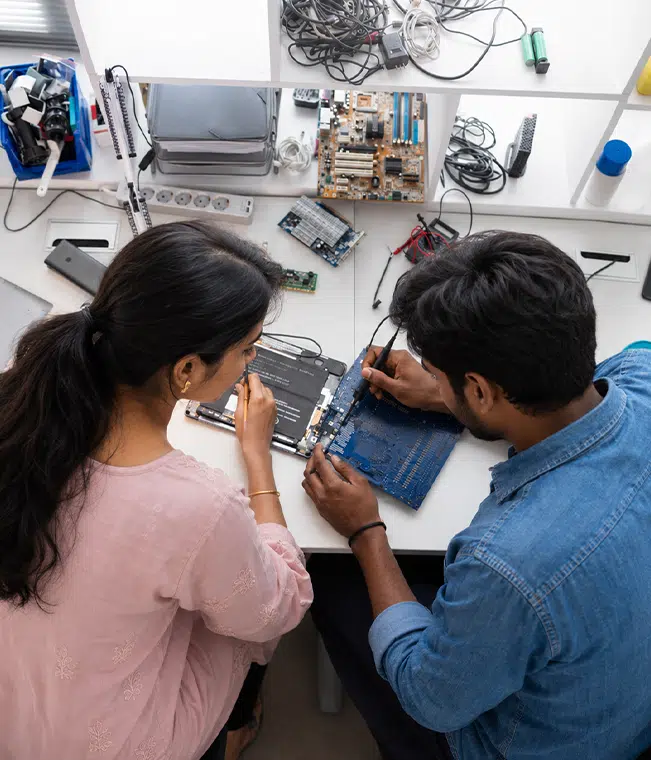
What Is Embedron Embedded Systems and Why It Matters?
A Course Built Because Existing Ones Weren’t Working
Industry Relevance - Why This Course Matters Right Now
Why It Matters Now - And Why Waiting Costs You
What Embedron Sets Out To Achieve






What You’ll Be Able To Do After 270 Days
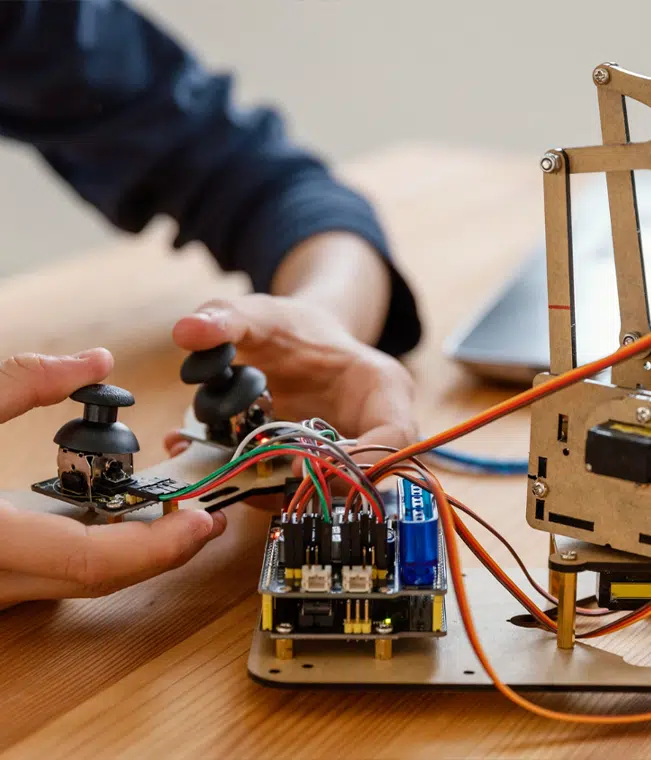
Who Embedron Is Built For
You Should Enroll If You Are…
- A 2nd, 3rd, or 4th year B.E./B.Tech student in ECE, EEE, CSE, Mechanical, Mechatronics, IT, or AI & Data Science - looking for a serious technical specialization beyond your coursework.
- A recent engineering graduate unsatisfied with how little hands-on work your degree included, ready to invest 270 days into becoming genuinely employable in embedded, IoT, or automation.
- A diploma holder or polytechnic graduate wanting to bridge into product engineering or R&D roles that traditionally favoured degree candidates.
- A career switcher from IT services who wants to move into deep-tech - robotics, EV, drones, agritech - and needs a credible, evidence-backed entry path.
- A future entrepreneur with a problem you’ve seen in your home district - an inefficient farm, a chaotic local clinic, a transport bottleneck - and you want the technical depth to actually solve it.
Prerequisites You Should Have
- Basic familiarity with the C programming language (loops, conditions, functions, arrays).
- School-level understanding of physics and mathematics - voltage, current, basic algebra.
- Curiosity about how things work, and a willingness to break a circuit on purpose to understand why.
Why Embedron Stands Apart From Every Other Embedded Course
| Highlight | What It Actually Means For You |
|---|---|
| 70/30 Practical-to-Theory Ratio | Every concept is taught on real hardware first. Theory follows in short bursts to formalize what your hands have already built. No four-hour lecture marathons. |
| Four Industry Tracks | You choose Agriculture, Manufacturing, Defense, or Transport at Day 1. Every project, every dataset, every case study gets tailored to your chosen domain. You graduate as a specialist, not a generalist. |
| One Capstone Per Module | Four full-scale builds across the program. Each capstone is reviewed by an external industry panel and goes straight into your placement portfolio. |
| Real Hardware, Real Problems | You solder, you flash, you fly, you drive, you deploy. Simulators are used to support - never to replace - physical building. |
| Industry 4.0 As Core, Not Elective | Edge AI, MQTT, OPC-UA, predictive maintenance, and digital twins are taught alongside the basics. You graduate knowing the stack actual factories use right now. |
| Internship-Ready From Module 2 | By Day 90 your portfolio is strong enough to apply to real internships. By Day 180 you are placement-ready. |
| Mentor-Reviewed GitHub Portfolio | Every project lives in a public repository with a polished README. Recruiters can verify what you say in a 30-second click. |
Features That Reflect How Embedded Engineering Is Actually Taught

Failure-Driven Mastery

Iterative Product Cycles

Public Demonstration Discipline

Daily Lab Logbook

Pair Programming, Paired Building

Small Cohorts, Real Mentorship
The Full Curriculum - Module By Module

Module 1 - Foundations of Embedded Systems & Electronics (Days 1–45)
- Week 1 - Electronics Refresher & Lab Setup: Multimeter mastery, RC filters, diodes, transistor switching, regulators, soldering basics.
- Week 2 - Arduino & Embedded C Essentials: AVR architecture, GPIO, PWM, ADC, interrupts, and timers explained through hands-on labs.
- Week 3 - Communication Protocols: UART, I2C, SPI, and 1-Wire — each protocol learned through a working sensor or display.
- Week 4 - Sensors & Actuators Deep Dive: Environmental, motion, industrial sensors plus DC motor, servo, stepper, and relay control.
- Week 5 - ESP32 and STM32 Step-Up: Wi-Fi scanning, deep-sleep, STM32 CubeMX, HAL, and DMA explored side by side.
- Week 6 - PCB Design Fundamentals: Schematic capture, footprint mapping, layout, ground planes, DRC, Gerber export in KiCAD.
- Week 7 - Track-Specific Mini Projects: Three mini projects tailored to your chosen industry track.
- Week 8 - Module 1 Capstone: Smart Multi-Sensor Node with local display, SD logging, low-power sleep, and a 3D-printed enclosure.
Module 2 - Embedded Communication, IoT & Cloud Integration (Days 46–90)
- Week 1 - Wi-Fi & TCP/IP Deep Dive: Sockets, HTTP REST, WebSockets, ESP32 web servers, captive portals.
- Week 2 - MQTT, Brokers & Cloud Platforms: Mosquitto, HiveMQ Cloud, ThingsBoard, Blynk, Firebase, and TLS-secured MQTT.
- Week 3 - LoRa, LoRaWAN & Long-Range Wireless: SX1278 point-to-point, The Things Network, cellular IoT, and BLE with GATT.
- Week 4 - Edge Gateways & Node-RED: Raspberry Pi as gateway, Node-RED flows, InfluxDB + Grafana stack, OTA updates.
- Week 5 - Flutter Mobile App Development: Dart fundamentals, BLE in Flutter, MQTT clients on mobile, FCM push notifications.
- Week 6 - IoT Security & Reliability: OWASP IoT Top 10, X.509 certificates, secure boot, signed OTA, watchdogs.
- Week 7 - Track-Specific Mini Projects: Three project deliverables aligned to your chosen industry.
- Week 8 - Module 2 Capstone: Full-stack IoT product - field device, Pi gateway, cloud dashboard, mobile app, TLS, and OTA.

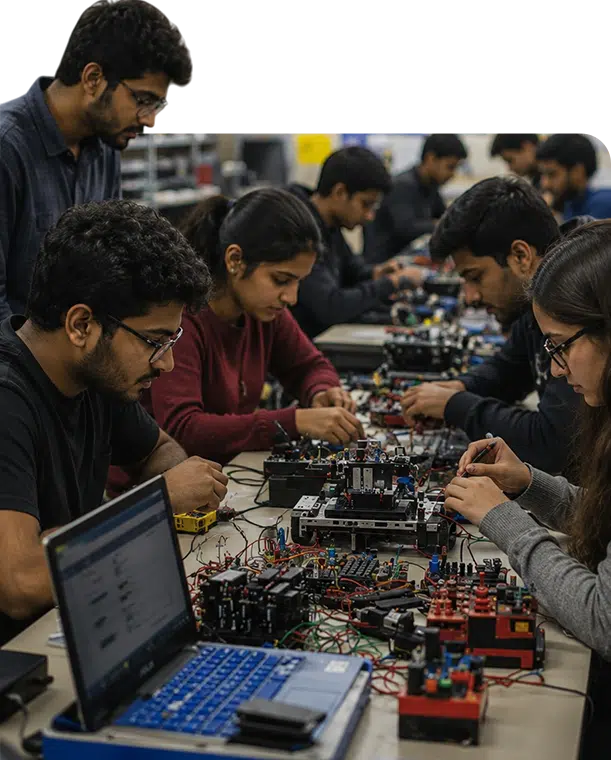
Module 3 - Robotics, Drone Technology & Mechatronics (Days 91–135)
- Week 1 - Robotics Foundations & Kinematics: DC motors, encoders, gearboxes, motor drivers, differential drive math, PID speed control.
- Week 2 - Sensors for Robots: IMU sensor fusion, ultrasonic arrays, IR line sensors, ToF, 2D LiDAR (RPLiDAR A1), USB cameras.
- Week 3 - ROS 2 Humble: Nodes, topics, services, parameters, launch files, URDF, TF2 transform trees.
- Week 4 - SLAM, Navigation & Autonomy: Odometry, slam_toolbox, AMCL localization, Nav2 path planning, behaviour trees.
- Week 5 - Drone Anatomy & First Flight: Multirotor physics, ESC and motor pairing, Pixhawk wiring, calibration, tethered hover.
- Week 6 - Autonomous Drone Programming: ArduPilot SITL, MAVLink, DroneKit-Python, geofencing, RTL, real autonomous mission.
- Week 7 - Track-Specific Mini Projects: Robot or drone tasks aligned to your industry track.
- Week 8 - Module 3 Capstone: Coordinated robot + drone mission with shared cloud dashboard and decision-branching logic.
Skill Outcomes: Tune PID controllers; author URDF robot descriptions; build SLAM maps; configure Nav2; calibrate and fly a quadcopter; write MAVLink-driven missions; understand DGCA drone regulations.
Module 4 - Industrial Automation, AI Integration & Capstone (Days 136-180)
- Week 1 - Industrial Automation & PLC Programming: Automation pyramid, PLC architecture, Ladder Logic, Structured Text, FBD, Modbus.
- Week 2 - SCADA, HMI & Industrial Communication: Ignition Maker, FUXA, ISA-101 HMI design, OPC-UA bridging, Modbus TCP deep dive.
- Week 3 - Edge AI Foundations & TinyML: TensorFlow Lite Micro, Edge Impulse Studio, keyword spotting, vision AI on MCU, quantization.
- Week 4 - Predictive Maintenance & Sensor Fusion: Vibration FFT, anomaly autoencoders, current signature analysis, multi-sensor fusion.
- Week 5 - Digital Twins & Cloud Integration: Azure Digital Twins, DTDL modelling, bidirectional twin commands, OEE, IEC 62443 OT security.
- Week 6 - Capstone Build & Career Launch: Final integrated build, demo rehearsal, resume polishing, mock interviews, demo day.

Where Embedron Takes You In The Real Economy
Hiring Industries Actively Recruiting Embedron-Style Graduates
- Automotive & EV: Tata Motors, Mahindra Electric, Bajaj Auto, Ola Electric, Ather Energy, TVS Motors, Ashok Leyland, Bosch India.
- Industrial & Manufacturing: Siemens India, L&T, Honeywell, Delta Electronics, Yokogawa, Rockwell Automation, ABB.
- Agritech: Stellapps, CropIn, DeHaat, Fasal, Jain Irrigation, ITC ABD, Ninjacart.
- Defense & Aerospace: DRDO, BEL, BDL, HAL, Tata Advanced Systems, L&T Defence, iDEX ecosystem startups.
- Drones & UAS: Garuda Aerospace, ideaForge, Drone Destination, Skye Air, Marut Drones.
- Embedded Product Companies: Tata Elxsi, Wipro, HCL Tech, Cyient, Mistral Solutions, eInfochips.
Industry Applications You Will Actually Build
- A field-deployable soil and air monitoring station with seven-day battery autonomy.
- A vibration-based predictive maintenance node that warns of bearing failure days in advance.
- A LoRa-mesh perimeter monitor for surveillance applications.
- An EV battery telematics module that scores driver behaviour and forecasts pack range.
- A precision-irrigation digital twin that auto-throttles drip valves based on plant stress detection.
Real-World Use Cases Aligned With Indian Industry
Market Demand Snapshot
According to NASSCOM’s 2025 deep-tech talent assessment, India’s embedded and IoT engineering workforce needs to expand by 4× over the next four years to meet domestic and export demand. Edge AI roles command salary premiums of 35–60% over generic firmware roles. Drone-certified engineers see entry-level offers from ₹5 LPA at agritech startups to ₹11 LPA at aerospace primes.
The Next 270 Days Will Pass Either Way
Career Pathways After Embedron
Career Growth Trajectories
- The Specialist Arc: Junior firmware engineer → senior firmware engineer → tech lead at a product company. CTC trajectory: ₹5 → ₹15 → ₹25+ LPA.
- The Architect Arc: IoT developer → solutions architect → product manager at an IoT platform company. CTC trajectory: ₹6 → ₹18 → ₹30+ LPA.
- The Founder Arc: Capstone idea → working prototype during program → angel funding within 18 months → first seed round. India’s iDEX, Atal Innovation, and ARISE-Atal programmes actively fund Embedron-style graduates.
| Career Pathway | Typical Starting Role | Indicative CTC (₹ LPA) | Best-Aligned Track |
|---|---|---|---|
| Embedded Firmware Engineering | Junior Embedded Engineer | 4 – 7 | Any |
| IoT Solutions Engineering | IoT Developer | 5 – 9 | Agriculture / Transport |
| Industrial Automation | PLC / SCADA Engineer | 4 – 8 | Manufacturing |
| Edge AI & TinyML | Edge AI Engineer | 8 – 14 | Any |
| Robotics Engineering | Robotics Engineer | 6 – 12 | Manufacturing / Defense |
| Drone Engineering | UAV Engineer / Remote Pilot | 5 – 11 | Agriculture / Defense |
| EV & Battery Systems | BMS Engineer / EV Telematics | 6 – 12 | Transport |
| Deep-Tech Entrepreneurship | Founder / Co-Founder | Variable | Any |
Where The Field Is Going - And How Embedron Stays Ahead
Technology Trends Already Inside The Curriculum
Certification Roadmap We Recommend Alongside Embedron
| Certification | Why It Helps |
|---|---|
| AWS IoT Specialty / Azure AZ-220 IoT Developer | For cloud-IoT roles, complements Embedron’s hands-on cloud labs. |
| Google Cloud Professional Cloud Developer | For full-stack IoT platform engineering roles. |
| ARM Accredited Engineer | For serious embedded firmware careers. |
| DGCA Remote Pilot Certificate | Mandatory for any drone career in India. |
| ISA Certified Automation Professional (CAP) | For automation and PLC engineering progression. |
| Edge Impulse Certified Developer | Increasingly recognized for TinyML and edge AI roles. |
Advanced Learning Path After Embedron
- Advanced Edge AI: Coral, Jetson Nano, on-device LLM agents, vision transformers at the edge.
- Advanced Robotics: ROS 2 multi-agent fleets, manipulation, ROS 2 with DDS over TSN, MoveIt 2 motion planning.
- Advanced Industrial Automation: Asset Administration Shell (AAS), OPC-UA over TSN, IEC 62443 OT security certification.
- Advanced Drone Technology: BVLOS operations, RTK-GPS, advanced ArduPilot custom modes, swarm coordination.
How The Curriculum Progresses From Beginner To Advanced
Skill Progression Structure
| Tier | Module | What You Walk In With | What You Walk Out With |
|---|---|---|---|
| Foundation Tier | Module 1 | Basic C, school-level physics | Can build, code, and debug microcontroller systems; can design a 2-layer PCB |
| Connectivity Tier | Module 2 | Module 1 competencies | Can ship a full-stack IoT product with secure cloud integration and a mobile app |
| Mobility Tier | Module 3 | Modules 1 and 2 competencies | Can assemble and program both a mobile robot and a quadcopter, with autonomy |
| Industry 4.0 Tier | Module 4 | Modules 1–3 competencies | Can architect a PLC + edge AI + cloud + mobile system for a real industry use case |
Certification That Recruiters Can Verify In One Click
| Certificate | Award Criteria |
|---|---|
| Embedron Foundation Certificate | Successful completion of Module 1. |
| Embedron IoT Specialist Certificate | Successful completion of Modules 1 and 2. |
| Embedron Robotics & Drones Certificate | Successful completion of Modules 1, 2, and 3. |
| Embedron Industry 4.0 Practitioner | All four modules completed with capstone score ≥ 60%. |
| Embedron Distinction Award | All four modules with overall ≥ 85% and capstone ≥ 85%. |
What’s Inside Your Certificate Pack
- Printed certificate with QR-verifiable serial number.
- Detailed transcript listing all 120 lab experiments, all mini projects, and the four capstones with grades.
- LinkedIn-ready badge image for each completed module.
- Verifiable public credential URL you can paste into resumes and applications.
- Portfolio review and curated GitHub profile for placement use.
The Stack You’ll Be Fluent In
What You Build - Projects And Track-Specific Case Studies
Module 1 Capstone - Smart Multi-Sensor Node
Module 2 Capstone - End-to-End IoT Product
Module 3 Capstone - Coordinated Robot & Drone Mission
Module 4 Capstone - Industry 4.0 Integrated System
Track-Specific Capstone Snapshots
- Agriculture 4.0: Precision greenhouse command centre with PLC-controlled irrigation, edge AI plant-stress detection, OPC-UA flow to Azure Digital Twins, and a Flutter mobile control app.
- Manufacturing 4.0: Conveyor predictive-maintenance system with vibration and current sensors, edge AI anomaly detection, Modbus TCP to Node-RED, InfluxDB + Grafana, and twin-driven setpoint commands.
- Defense 4.0:Hardened edge AI sentry node with acoustic threat classifier, encrypted LoRa relays, air-gapped ThingsBoard command post, and mTLS mobile app for command staff.
- Transport 4.0: EV battery telematics system with custom BMS firmware over CAN, driver-behaviour edge AI, 4G uplink to a digital twin, and a fleet-manager Flutter app.
Why Choose Embedron Over Other Embedded Courses

You Learn On Real Hardware, Not Simulators

You Specialize, You Don’t Generalize

You Get An Internship-Ready Threshold Mid-Program

You Walk Out With A Public Portfolio

You Are Taught By Builders, Not Lecturers

You Are Future-Proofed
Talk To An Embedron Programme Counsellor
What To Expect On The Call
- A 5-minute conversation about your current year, branch, and career interests.
- A walkthrough of the four industry tracks and which one fits your goals.
- A clear breakdown of fees, scholarship eligibility, and installment options.
- An honest take on whether Embedron is the right course for you right now - or whether you should wait a semester.
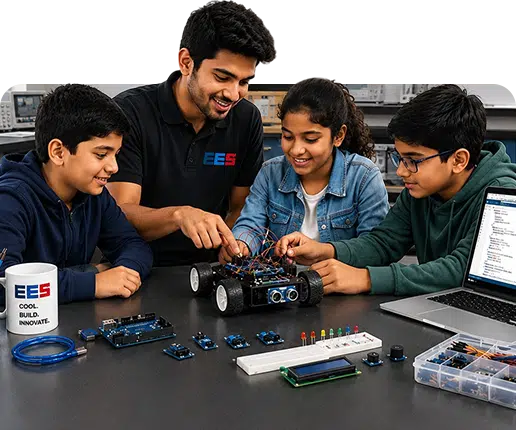
The Faculty Behind Embedron
Trainer Profile
- The anchor trainer holds a B.E. or B.Tech degree in ECE, EEE, or CSE with at least three years of embedded industry experience, and is comfortable across firmware, IoT, and at least one of robotics or automation. Every anchor trainer has shipped at least one full embedded product to production before being allowed to deliver Module 2 onwards.
- The assistant trainer holds a B.E. or B.Tech degree with at least one year of industry experience and supports lab supervision, daily logbook reviews, and one-on-one debugging help.
- Both trainers complete at least one TinyML or Edge AI refresher course every year, ensuring the curriculum stays grounded in current practice.
Mentor-To-Learner Ratios
- Theory sessions: 1 trainer per 24 learners (cap of 30).
- Lab sessions: 1 trainer per 8 learners.
- Capstone mentorship: 1 dedicated mentor per 6 learners.