
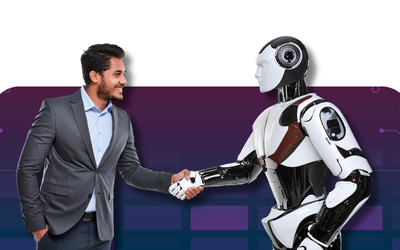





Robotics Course for School Students - Built for Curious Minds in Class 5 to 9

4 progressive modules · 16+ mini projects · 4 capstone builds

Aligned with NEP 2020 experiential-learning framework

270 contact hours of structured, project-based learning

Trainer-to-student ratio of 1:8 for personalised mentorship

Recognised Module + Programme Completion Certificates
Robotics Course for School Students - Complete Learning Guide

Why Electrobot Junior matters right now
Across the full 9-month programme, students complete more than 60 lab experiments, 16+ mini projects and 4 module-end capstone builds. The curriculum has been mapped against international STEM frameworks, the NEP 2020 vision for experiential learning, and global maker-education best practices, so the time your child spends with us also reinforces their school science and prepares them for the technology choices they will make in higher classes.
Industry Relevance, Spoken in a Child's Language
Every module is tied to a real industry that the child can see in everyday life. Smart-irrigation circuits in Module 1 connect to agriculture. Scratch logic in Module 2 mirrors how factory machines are programmed. Arduino sensor projects in Module 3 reflect smart-home and smart-farm products. Robotics builds in Module 4 echo warehouse AGVs and surveillance rovers. The child does not just learn — they begin to see the world differently.
By the end of Electrobot Junior, every learner will be able to do the following confidently:





Outcomes are mapped against four learning domains so that growth is visible to parents, trainers and the child themselves.
| Domain | Outcome | Evidence in the Programme |
|---|---|---|
| Cognitive (Knowledge) | Understand electricity, electronics, sensors, microcontrollers and programming logic. | Theory quizzes, viva-voce, lab notebook entries. |
| Psychomotor (Skill) | Build, wire, program, debug and test working electronic and robotic prototypes independently. | Practical labs, project demos, capstone builds. |
| Affective (Attitude) | Demonstrate curiosity, persistence, collaboration and a maker mindset. | Peer-review sessions, reflection logs, showcase days. |
| Industry-Linked | Identify how electronics and robotics drive real innovations across agriculture, manufacturing, defence and transport. | Industry-mapped projects in every module. |
Electrobot Junior has been designed specifically for the developmental stage of school-age learners. It is the right fit for the following groups:

Students of Class 5 to 9 (age 10 to 14)

Curious children who love taking things apart

Young learners preparing for higher classes in science

Future engineers, innovators and founders

Parents looking for a meaningful after-school programme

Schools and learning centres seeking a ready-to-deploy STEM curriculum
A quick scan of what makes the Electrobot Junior robotics course for school students different:
| Feature | What it Means | Why it Matters |
|---|---|---|
| 70:30 Practical-to-Theory ratio | Lab activity inside the same session as the concept. | Children retain through doing, not memorising. |
| Story-driven engineering | Every module wrapped around a real-world story. | The child always knows why they are building. |
| Iterative building | Failure is a celebrated step in the process. | Builds resilience and a real engineer's mindset. |
| Pair and team builds | Pair programming, peer review, team challenges. | Collaboration becomes a habit, not a slogan. |
| Capstone in every module | Original idea, feature or improvement required. | Children leave with a portfolio, not just notes. |
| Trainer-led safety culture | Daily safety briefings, ESD-safe mats, supervised tools. | Lab is rigorous, calm and parent-confident. |
Course Syllabus - Module-Wise Breakdown

Module 1 - Foundations of Electronics & STEM
| Duration | 45 Days · 67.5 hours |
| Learning Level | Absolute beginner |
| Mode | Instructor-led, hands-on lab |
| Capstone | Mini Smart Garden Indicator Box — senses light, heat and presence |
Lessons Covered: What is electricity, conductors vs insulators, component identification, multimeter use, Ohm's Law, breadboard prototyping, LEDs and polarity, series and parallel circuits, switches and pull-up logic, schematic reading, output devices (buzzer, motor), first sensors (LDR, thermistor), and capstone planning, build, demo.
Skill Outcomes: Read schematics, build series and parallel circuits, use a multimeter safely, apply Ohm's Law, work with sensors as variable resistors, and design an original simple electronic prototype.
Module 2 - Scratch Programming & Logic Building
| Duration | 45 Days · 67.5 hours |
| Learning Level | Beginner |
| Mode | Computer lab + classroom hands-on |
| Capstone | Innovate-a-Game — an original 3-level Scratch game with story, score and win/lose conditions |
Lessons Covered: Computational thinking, flowcharts, algorithm design, Scratch interface tour, sprites and costumes, events and motion, loops and repetition, variables and math, conditionals and sensing, logical operators, broadcasts, cloning, custom blocks, debug-the-game challenges, and the capstone game build.
Skill Outcomes: Use Scratch to design animations, quizzes and multi-level games; apply variables, loops, conditionals and events; decompose problems; debug logic errors; and present a polished original project.

Module 3 - Arduino Programming & Sensor Integration
| Duration | 45 Days · 67.5 hours |
| Learning Level | Intermediate beginner |
| Mode | Instructor-led, hands-on lab |
| Capstone | Smart Farm Mini Station — soil, climate and light sensing with automated responses |
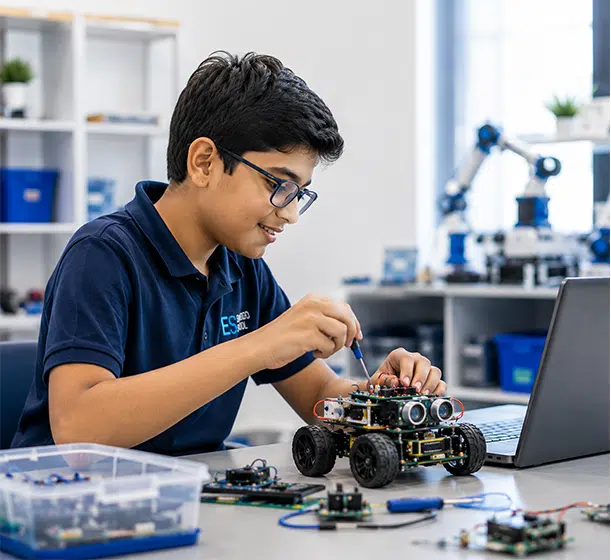
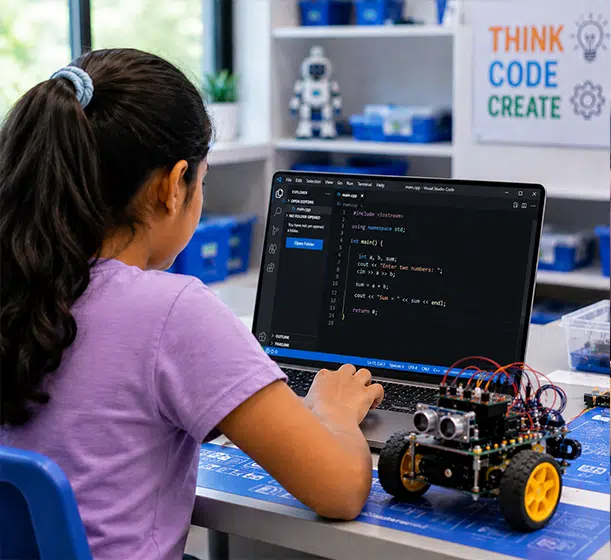
Lessons Covered: Microcontroller basics, Arduino UNO board tour, IDE setup, digital I/O, analog input and PWM, Serial Monitor, conditionals and loops in Arduino C, ultrasonic and IR sensing, DHT11 temperature and humidity, soil moisture and LDR, servo and DC motor control with L293D, and the smart-farm capstone.
Skill Outcomes: Write Arduino C sketches, drive digital and analog pins, interface six common sensors, control servo and DC motors via a motor driver, debug with Serial Monitor and ship a sensor-driven prototype.
Module 4 - Beginner Robotics & Innovation
| Duration | 45 Days · 67.5 hours |
| Learning Level | Beginner to intermediate |
| Mode | Hands-on lab + innovation studio |
| Capstone | Inno-Bot — an original multi-behaviour robot pitched to parents, mentors and judges |
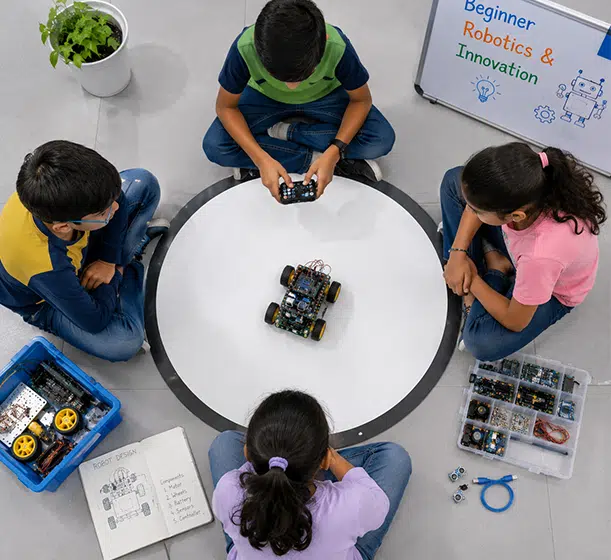
Lessons Covered: What is a robot, robot anatomy, chassis assembly, motor drivers (L293D / L298N), differential drive motion, HC-05 Bluetooth pairing and control, ultrasonic-based obstacle avoidance, IR-based line following, hybrid Bluetooth + autonomous behaviour, design-thinking workshop, capstone build and innovation showcase.
Skill Outcomes: Assemble a 2WD mobile robot, drive it through code, build line-following and obstacle-avoiding behaviours, integrate Bluetooth control, run a design-thinking sprint and pitch an original robot end-to-end.
Industry & Job Connect
Why this matters now
| Industry | Concept Introduced | Real-World Use Case | Long-Term Career Tracks |
|---|---|---|---|
| Agriculture | Soil-moisture and weather sensing | Smart irrigation, precision farming drones | AgriTech engineer, IoT solutions architect |
| Manufacturing | Conveyor logic, line-following bots | Warehouse AGVs, factory automation | Industrial automation engineer |
| Defence | Obstacle-avoiding rovers, alarms | Border-patrol bots, surveillance rovers | Defence electronics engineer |
| Transport | Traffic-light sequencing, Bluetooth car | Smart-city signals, ADAS in vehicles | Embedded automotive engineer |
| Healthcare & Safety | Door alarms, distance sensing | Smart bins, contact-less doors | Medical-device firmware engineer |
| Consumer Electronics | Buzzer, LED, motor projects | Smart appliances, wearables | IoT product engineer, hardware startup founder |
Ready to build real products, not just academic projects?
Career Pathways
| Stage | Programme | Outcome |
|---|---|---|
| School Foundation | Electrobot Junior | Maker mindset + electronics + Arduino + beginner robotics |
| School Advanced | Electrobot Senior | IoT, wireless communication, drone fundamentals, product development |
| College Foundation | Embedron | Industry-track embedded systems, IoT, robotics, drones, automation |
| College Advanced | Embedron+ | Industrial IoT, RTOS, Embedded Linux, Edge AI, Autonomous Robotics |
| Industry Track | EmbedX | Working professional certification in advanced industry applications |
Long-Term Job Roles
- Embedded Systems Engineer (Automotive, Industrial, Consumer)
- IoT Solutions Architect
- Robotics Engineer
- Drone Application Developer
- Industrial Automation Engineer
- AI + IoT Product Engineer
- Hardware Startup Founder
- Smart Manufacturing & Industry 4.0 Specialist
- Defence Electronics Engineer
- Smart Agriculture Technologist
Salary Insights (India, long-term reference)
| Role | Entry-Level (₹ p.a.) | Mid-Level (₹ p.a.) |
|---|---|---|
| Embedded Systems Engineer | 4 – 7 LPA | 10 – 18 LPA |
| IoT Solutions Engineer | 5 – 8 LPA | 12 – 22 LPA |
| Robotics Engineer | 5 – 9 LPA | 14 – 25 LPA |
| Industrial Automation Engineer | 4 – 6 LPA | 9 – 16 LPA |
| Drone Application Developer | 4 – 8 LPA | 10 – 20 LPA |
Future Roadmap
| Current Concept | Next-Level Technology | Long-Term Industry Path |
|---|---|---|
| Arduino + sensors | ESP32, STM32, RTOS, Embedded Linux | Embedded engineering, IoT product teams |
| Soil & weather sensors | Precision agriculture, drone spraying | AgriTech startups, smart-farming companies |
| Ultrasonic obstacle robot | SLAM, ADAS, autonomous vehicles | Automotive, robotics, AGVs |
| Line follower | Warehouse automation, factory AGVs | Smart logistics, manufacturing 4.0 |
| Bluetooth control | BLE, Wi-Fi, LoRa, NB-IoT, 5G IIoT | Connected products, industrial IoT |
| Scratch logic | Python, C, C++, AI/ML | Software engineering, data science |
| Capstone pitches | Product engineering, startup founding | Innovation labs, deep-tech entrepreneurship |
Curriculum Framework - Beginner to Advanced Mapping
| Total Modules | 4 |
| Duration per Module | 45 days (~9 weeks) |
| Daily Session | 1.5 hours (90 minutes) |
| Total Contact Hours per Module | 67.5 hours |
| Total Programme Contact Hours | 270 hours |
| Theory : Practical Ratio | 30% : 70% |
| Recommended Class Size | 12 to 18 students |
| Trainer-to-Student Ratio | 1 : 8 |
| Mode of Delivery | Instructor-led, in-person or hybrid |
Skill Progression Across the 4 Modules
| Skill | Module 1 | Module 2 | Module 3 | Module 4 |
|---|---|---|---|---|
| Problem solving | Beginner | Developing | Strong | Strong |
| Computational thinking | Beginner | Strong | Strong | Strong |
| Hands-on engineering | Strong | Beginner | Strong | Strong |
| Team collaboration | Beginner | Beginner | Developing | Strong |
| Creativity & innovation | Beginner | Developing | Developing | Strong |
| Debugging mindset | Beginner | Developing | Strong | Strong |
| Design thinking | Intro | Beginner | Beginner | Strong |
| Presentation & pitching | Intro | Beginner | Beginner | Strong |
Certification Details
| Certificate | Awarded For | Recognition |
|---|---|---|
| Module Completion Certificate (×4) | Completion of each module with at least 50% grade | Elysium-issued, module-specific |
| Programme Completion Certificate | Successful completion of all four modules | Elysium-issued, signed by Academic Head |
| Innovator Recognition Badge | Top 10% of overall capstone scores | Special Elysium Innovator Badge |
| Showcase Day Award | Best capstone in each module (jury-decided) | Elysium Excellence Award |
Tools & Technologies Covered

Hardware
- Arduino UNO R3 (ATmega328P microcontroller)
- Full-size breadboard, jumper wires (M-M, M-F, F-F)
- LEDs (red, green, yellow, blue), RGB LED, push buttons, buzzers
- Resistor packs (220 Ω to 10 kΩ), capacitors, BC547 transistor
- Sensors: LDR, soil moisture, DHT11 (temperature + humidity), HC-SR04 ultrasonic, IR module, PIR motion
- Actuators: SG90 servo motor, DC gear motors with wheels
- Drivers: L293D / L298N motor driver
- Communication: HC-05 Bluetooth module
- 2WD robot chassis kit, digital multimeter, USB cables and tool kit
Software
- Scratch (online and offline editor)
- Arduino IDE (latest stable release)
- TinkerCAD Circuits — for virtual breadboard and virtual Arduino
- Proteus — trainer-led schematic and simulation demos
- MIT App Inventor — optional companion mobile-app builds
- Built-in Arduino Serial Plotter for live data visualisation
- Fritzing — optional breadboard diagram drawing tool
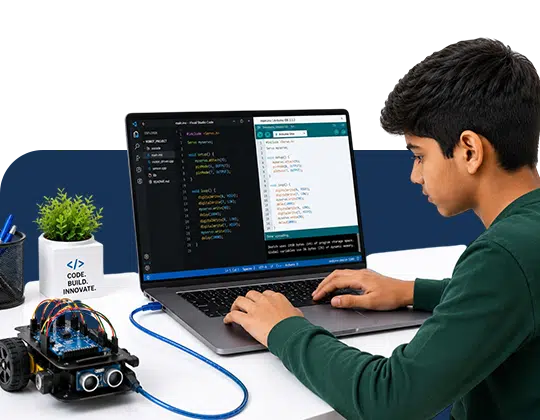
Projects & Case Studies
Module 1 Projects - Foundations of Electronics
- Smart Plant Companion Light — an LDR-and-transistor circuit that signals when a plant needs more light.
- Mini Doorbell with Memory Tone — push-button doorbell with controlled tone variation.
- Traffic Light Sequencer (Manual) — three-LED traffic light operated by buttons.
- Fridge Door Alarm — buzzer alert when a lid is left open.
- Capstone: Mini Smart Garden Indicator Box — light, heat and presence sensing in one decorated unit.
Module 2 Projects — Scratch Programming
- Animated Birthday Card — costume switching, broadcasts and a click-triggered surprise.
- Math Quiz Champion — variables, conditionals and live scoring across five questions.
- Healthy Food vs Junk Food Game — basket-style catch game with scoring rules.
- Smart Home Simulator — clickable house, individual lights and a master switch.
- Capstone: Innovate-a-Game — an original 3-level game with story, score and win/lose flow.
Module 3 Projects — Arduino & Sensor Integration
- Smart Plant Watering Reminder — soil-moisture-driven LED and buzzer alert.
- Smart Traffic Light System — full intersection with pedestrian button and timing logic.
- Smart Door with Ultrasonic + Servo — automatic open / close based on proximity.
- Capstone: Smart Farm Mini Station — soil, climate and light sensing with automated valve, fan and alert responses.
- IoT Solutions Architect
Module 4 Projects — Beginner Robotics & Innovation
- Bluetooth Voice / Button Controlled Car — phone-driven 2WD car.
- Smart Surveillance Rover — auto-avoid rover with PIR-triggered alarm and LED flash.
- Floor-Plan Line Follower — hospital-corridor delivery scenario with IR-based path tracking.
- Capstone: Inno-Bot — original multi-behaviour robot pitched to parents and mentors on Showcase Day.
Why Choose This Course

A full curriculum, not a sampler.

A 70% practical model that respects how children learn.

A clear progression ladder.

Aligned with NEP 2020 and global STEM frameworks.

Industry-grade learning kits in every child's hands.

Trainer-to-student ratio of 1:8.

Real innovation, not copy-paste projects
Talk to an Elysium Counsellor - We respond within one working day

Trainer & Mentor Section
- Minimum qualification: B.E. or B.Tech in Electronics, Electrical, Computer Science or Mechatronics.
- Demonstrated experience working with Arduino, sensors and beginner robotics.
- Completion of Elysium's four-week Trainer Certification Bootcamp.
- Comfort and patience working with children aged 10 to 14.
- Strong communication, storytelling and classroom-management skills.
- Familiarity with Scratch, the Arduino IDE and TinkerCAD.
Testimonials
Mrs. Kavitha Ramesh
Parent of Arjun
The capstone project changed something for me. I learned that breaking things is part of the work — and that I am allowed to fix them.
Ms. Sneha Iyer
Government School
As a school, we needed a turnkey robotics curriculum that does not need our teachers to re-learn the field. Electrobot Junior delivered that, lesson by lesson.