





Electrobot Senior - Advanced Embedded Systems Course for School Students

270 hours of hands-on training

60+ lab
experiments

16+ industry
projects

4 capstones - 70%
practical

Direct pathway to Elysium Embedron
Robotics Course for School Students - Complete Learning Guide
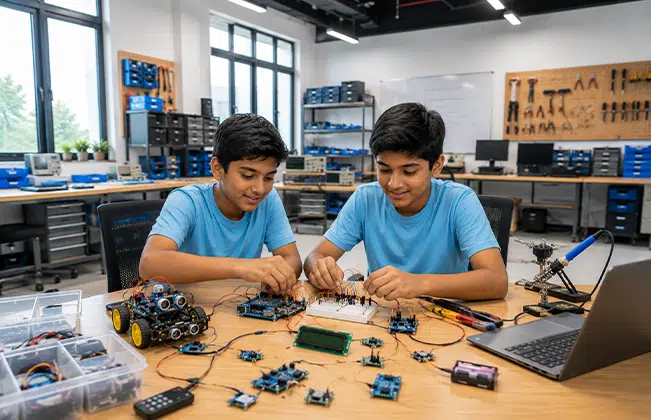
An Industry-Grade Embedded Systems Course Built for Grade 9–12 Students
Electrobot Senior is the advanced school program from Elysium Embedded School. It picks up where Electrobot Junior ends — or where any motivated student who already knows the basics of Arduino and electronics is ready to go deeper. Over six months, students move from intermediate microcontroller skills to building, flying and pitching their own industry-grade prototype.
The course exists because there is a real gap. School STEM clubs give students a taste of electronics. Engineering colleges expect them to know how things actually work. Electrobot Senior bridges that gap on purpose. Each module is structured like a junior engineering studio: short theory, long practicals, daily logbooks, weekly demos, and a capstone every six weeks.

Why this course matters now

Industry relevance at a glance
By the end of the program, every student should be able to:







Skills, Mindset and Portfolio — What You Walk Away With

Is Electrobot Senior the Right Program for You?
Embedron+ is intentionally advanced. It works best when you already have a basic foundation, so that you can spend your time learning the difficult, valuable parts. Here is who tends to get the most out of it.




Course Highlights at a Glance
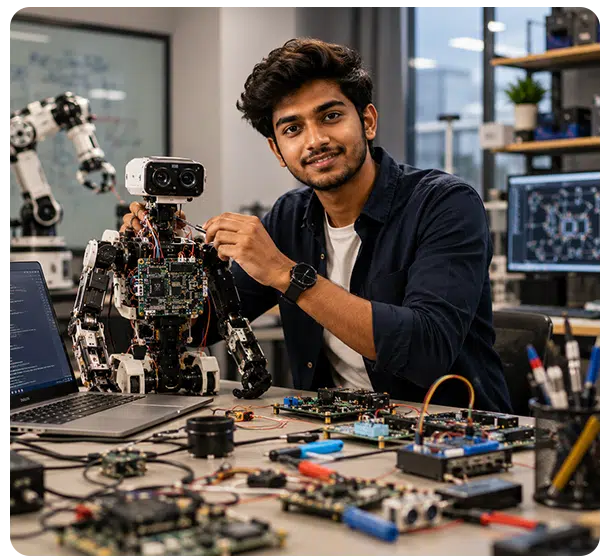
Why Electrobot Junior matters right now
| Feature | What It Means For You |
|---|---|
| 5-Pillar Learning Framework | Discover → Design → Develop → Deploy → Disrupt. Every concept moves through all five. |
| Strict 70/30 Practical/Theory Split | You will spend more time at a breadboard than at a slide. |
| Industry-Style Lab Manual | Every experiment uses the same structure used in professional R&D labs. |
| Daily Lab Logbook | Trainer-signed daily, parent-visible monthly. |
| 4 Capstone Projects | Smart Home Hub, Smart Agriculture System, Object-Following Robot, Industrial Drone. |
| PCB Design Module | You will design, route and quote a real 2-layer PCB. |
| Live Drone Flight Sessions | Under instructor supervision, in safe tethered and open-ground zones. |
| Startup-Style Final Pitch | The program ends with you pitching your product to a panel. |
| Failure-Friendly Labs | A broken circuit is a lesson, not a punishment. |
| Continuous Trainer Feedback | Weekly written notes, monthly parent reviews, anonymous student feedback. |
Course Syllabus - Detailed Module-Wise Syllabus
Module 1 - Advanced Arduino & Embedded Foundations

Skill Outcomes : You will be able to architect 32-bit microcontroller applications, develop multi-tasking RTOS firmware, design and bring up a two-layer PCB, and deploy applications on embedded Linux platforms.
Duration: 45 days · Level: Intermediate to Advanced (School Level) · Capstone: Smart Home Mini-Hub
Module 1 hardens the basics. You move from “Arduino works” to “I can read its registers and write non-blocking code”. You learn embedded C properly — timers, interrupts, structs, pointers and state machines — and you wire up the sensors and actuators that every embedded engineer is expected to know.
Lesson-Wise Highlights
- Week 1 — Embedded Foundations: Arduino architecture, GPIO, ADC/DAC, PWM, timers, interrupts; lab: multi-LED non-blocking patterns using millis().
- Week 2 — Sensors Deep Dive: Digital and analog sensors, calibration, signal conditioning, noise filtering; lab: DHT22 + BMP280 + OLED weather monitor.
- Week 3 — Actuators & Motors: Servos, steppers, DC motors, H-bridge drivers; lab: programmable robotic arm.
- Week 4 — Communication Protocols: UART, I2C, SPI, Bluetooth basics; lab: two-Arduino I2C master-slave system.
- Week 5 — Embedded C Mastery: Functions, structs, pointers, libraries, state machines; lab: multi-zone smart lighting controller.
- Week 6 — Mini Capstone Build: System integration, debugging, documentation; capstone: Smart Home Mini-Hub.
- Week 7 — Showcase & Assessment: Project polishing, viva, peer review, portfolio submission.
Duration: 45 days · Level: Advanced (School Level) · Capstone: Smart Agriculture Monitoring System
Module 2 connects everything to the internet. You graduate from an Arduino in front of you to an ESP32 talking to a cloud dashboard on the other side of the city. MQTT, HTTP, BLE, LoRa, GSM — every wireless layer used in real IoT products.
Lesson-Wise Highlights
- Week 1 — ESP32 & WiFi Foundations: ESP32 architecture, WiFi STA/AP, HTTP, OTA introduction; lab: WiFi sensor web server.
- Week 2 — MQTT & Real-Time IoT: MQTT protocol, brokers, topics, QoS, security; lab: ESP32 → HiveMQ → Node-RED dashboard.
- Week 3 — Cloud Platforms: Blynk, ThingSpeak, AWS IoT Core introduction; lab: multi-sensor cloud dashboard.
- Week 4 — Mobile App Integration: MIT App Inventor, BLE pairing, app-to-device control; lab: mobile-controlled smart device.
- Week 5 — Long-Range Comms: LoRa, GSM (SIM800L), SMS alerts, deep-sleep; lab: LoRa farm-to-base 1 km link.
- Week 6 — IoT Capstone Build: Integration, security, basic data analytics; capstone: Smart Agriculture Monitoring System.
- Week 7 — Showcase & Assessment: Dashboards, mobile demo, viva, portfolio.
Module 2 - IoT, Wireless Communication & Cloud
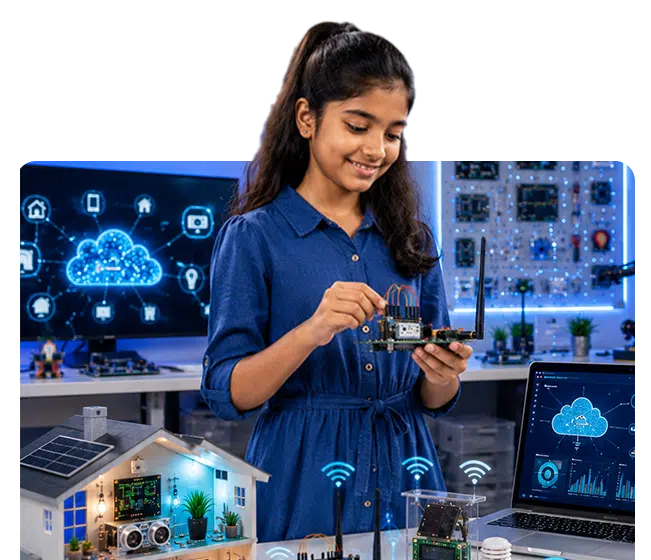
Skill outcomes per module: WiFi and Bluetooth on ESP32, MQTT, cloud dashboards, mobile apps, LoRa long-range, GSM alerts, security basics, power-aware IoT design.
Module 3 - Robotics, AI Vision & Autonomous Systems
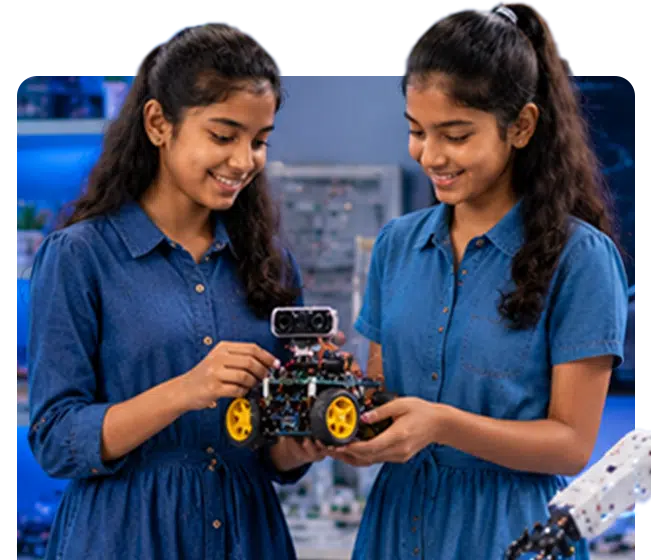
Skill outcomes per module: robot build, motor control, PID tuning, Raspberry Pi development, OpenCV pipelines, edge ML, ROS basics, simulation in Gazebo/Webots.
Duration: 45 days · Level: Advanced (School Level) · Capstone: Object-Following Smart Robot
Module 3 is where the program leaves the workbench and starts moving. You build a 4WD robot from scratch, layer in obstacle avoidance and PID control, bring in a Raspberry Pi as a high-level brain, and finish with a robot that can see, decide and follow.
Lesson-Wise Highlights
- Week 1 — Robotics Foundations: Robot anatomy, motors, drivers, basic kinematics; lab: manual 4WD robot.
- Week 2 — Sensor-Driven Robots: Line-following, obstacle avoidance, PID intro; lab: PID-tuned line follower.
- Week 3 — Raspberry Pi Mastery: Linux basics, Python, GPIO, camera; lab: Pi-based remote-controlled car.
- Week 4 — Computer Vision: OpenCV, color detection, contours, face detection; lab: color-tracking robot.
- Week 5 — Edge AI & ROS Intro: Edge Impulse, TFLite, ROS concepts, Gazebo; lab: edge AI gesture recognition.
- Week 6 — Robotics Capstone: Vision + control + comms integration; capstone: Object-Following Smart Robot.
- Week 7 — Showcase & Assessment: Demo, viva, portfolio, peer review.
Duration: 45 days · Level: Expert (School Level) · Capstone: Custom Industrial Drone Prototype + Product Pitch
The final module is where you become a product engineer. You build a quadcopter from a frame, calibrate it, fly it, design a custom PCB sensor payload, and pitch the whole thing in a 5-minute investor-style deck. By the end, you are not just a student — you have shipped something.
Lesson-Wise Highlights
- Week 1 — Drone Fundamentals: Aerodynamics, components, DGCA basics; lab: component identification and frame build.
- Week 2 — Build & Wire: Frame, motors, ESCs, FC, receiver, PDB; lab: drone assembly and pre-flight checks.
- Week 3 — Calibration & First Flight: Mission Planner / Betaflight, PID, failsafe; lab: tethered hover under supervision.
- Week 4 — Advanced Drone Features: Waypoints, GPS missions, FPV; lab: autonomous waypoint mission.
- Week 5 — PCB & Productization: KiCAD basics, schematic, layout, BOM; lab: custom PCB for a sensor module.
- Week 6 — Product Capstone Build: Full industrial drone prototype with PCB and pitch.
- Week 7 — Showcase, Pitch & Assessment: Final demo, investor-style pitch, portfolio review.
Module 4 - Drone Technology & Product Development

Skill outcomes per module: quadcopter assembly, flight controller configuration, autonomous missions, FPV setup, PCB design and Gerber generation, product engineering thinking, pitch deck craft.
Industry & Job Connect
How Electrobot Senior Maps to Real Industries
Market Demand
| Industry | Where You See It In The Course | Real-World Use Cases |
|---|---|---|
| Agriculture | Soil monitor, smart watering, livestock LoRa tracker, crop-health AI, survey drone | Precision farming, AgriTech startups, drone spraying, greenhouse climate control |
| Manufacturing | Conveyor counter, vision sorting, cobots, custom PCB | Smart factories, Industry 4.0 cells, quality inspection, AGVs |
| Defense | Perimeter sensing, surveillance robot, encrypted drone telemetry | Reconnaissance UAVs, tactical comms, autonomous patrol systems |
| Transport | Reverse-park assistant, fleet tracker, autonomous AGV, delivery drone | ADAS aftermarket, logistics, EV monitoring, last-mile delivery |
Career Pathways After Electrobot Senior
Electrobot Senior is a school program, so the immediate destination is not a job — it is engineering college, an internship, or a serious science fair. But the skills you walk away with are the same ones that lead, in five to seven years, to some of the most in-demand technical roles in the country.
Future job roles this course prepares you for - Embedded Systems Engineer - IoT Solutions Engineer - Robotics Engineer - Drone Systems Engineer - Edge AI / TinyML Engineer - Hardware Design Engineer (PCB) - Industry 4.0 Automation Engineer - Hardware Startup Founder
Salary insights (India, indicative entry-level after engineering) - Embedded Systems Engineer: ₹4–8 LPA - IoT Engineer: ₹5–10 LPA - Robotics Engineer: ₹5–11 LPA - Drone Engineer / Operator: ₹4–9 LPA - Edge AI Engineer: ₹6–14 LPA
(Figures are indicative ranges for fresh engineering graduates in India and vary by city, company and skill depth. Verify with current market data before sharing externally.)
Career growth opportunities - Direct entry into Elysium’s Embedron college program. - Strong base for an Atal Tinkering Lab leadership role at school. - Eligibility for school-level summer internships and product-startup shadowing. - Portfolio strong enough to support engineering scholarship and admission applications. - Headstart toward a long-term founder track in hardware and deep-tech.
FUTURE ROADMAP
Where You Go After Electrobot Senior
Technology trends we are tracking and integrating
- TinyML and Edge AI — dedicated mini-track in upcoming editions.
- AIoT — combined AI + IoT use cases in agriculture and smart cities.
- Autonomous mobility — lane-following and obstacle avoidance for toy cars.
- Drone swarms — multi-drone coordinated missions.
- Cybersecurity for IoT — hands-on TLS, secure boot, OTA labs.
- Industry 4.0 — mini smart-factory cells and OPC-UA introduction.
- Sustainability — solar-powered nodes and energy-efficient firmware.
- Generative AI for engineering — using LLM tools to accelerate firmware writing.
| Time Horizon | Recommended Next Step |
|---|---|
| Immediately after the program | Apply to Elysium Embedron (college-level program), early-bird track |
| During Grades 11–12 | National hackathons, Atal Tinkering Lab leadership, robotics olympiads |
| Pre-college internship | Internship-readiness track via Elysium’s Industry Partner Network |
| Engineering admission | Use the GitHub portfolio + capstones to strengthen applications |
| After Class 12 | Embedron+ enrollment + part-time work on real product modules |
| Long term | Career as an embedded, IoT, robotics or drone engineer — or founder |
Ready to build real products, not just academic projects?
CURRICULUM FRAMEWORK
How the Course Progresses — Beginner to Advanced
| Stage | Where In The Course | What Changes |
|---|---|---|
| Refresher (Optional) | 7-day Bridge Bootcamp | Basics of electronics and Arduino for non-Junior graduates |
| Foundations | Module 1 | Microcontroller mastery, sensors, embedded C |
| Connected | Module 2 | Cloud, MQTT, mobile apps, long-range comms |
| Intelligent | Module 3 | Robotics, vision, edge ML |
| Productized | Module 4 | Drone, PCB, packaging, pitch |
| Mastery Showcase | Final Week | Public demo, portfolio submission, certification |
CERTIFICATION DETAILS
Certifications You Will Earn
| Stage | Certificate | Awarded On |
|---|---|---|
| Module 1 | Certified Embedded Beginner — Arduino Foundations | Module 1 capstone success |
| Module 2 | Certified IoT & Cloud Innovator | Module 2 capstone success |
| Module 3 | Certified Robotics & AI Vision Practitioner | Module 3 capstone success |
| Module 4 | Certified Drone & Embedded Product Engineer | Module 4 capstone + pitch |
| Program Master | Elysium Electrobot Senior — Advanced Embedded Innovator | All four modules at Grade B or higher |
| Honour | Elysium Innovator’s Medal | A+ grade with notable innovation |
Tools & Technologies Covered
Tools and Technologies You Will Use

The toolkit is intentionally large — because a real embedded engineer is not loyal to one IDE or one board. You will become comfortable with the workflow used in actual product teams.
Microcontrollers and computers Arduino Uno, Arduino Nano, Arduino Mega, ESP32 DevKit, ESP8266 NodeMCU, STM32 Blue Pill (introduction), Raspberry Pi 4 (4 GB).
Sensors DHT22, BMP280, MQ-series gas sensors, soil moisture, ultrasonic HC-SR04, IR, PIR, LDR, ACS712 current, MPU6050 IMU, GPS NEO-6M, MAX30102 pulse.
Actuators SG90 / MG996R servos, DC gear motors, 28BYJ-48 stepper, 5V/12V relays, buzzers, LEDs, WS2812B RGB strips.
Communication WiFi, Bluetooth Classic and BLE, HC-05, nRF24L01, LoRa SX1278, SIM800L GSM, RFID RC522, ESP-NOW.
Robotics and AI 4WD chassis, L298N driver, line-following sensors, 3-DOF gripper arm, ESP32-CAM, OpenMV Cam, Pi Camera v2.
Drone hardware F450 frame, BLDC motors, 30A ESCs, F4/F7 flight controller, FrSky receiver and Taranis transmitter, LiPo battery, propellers.
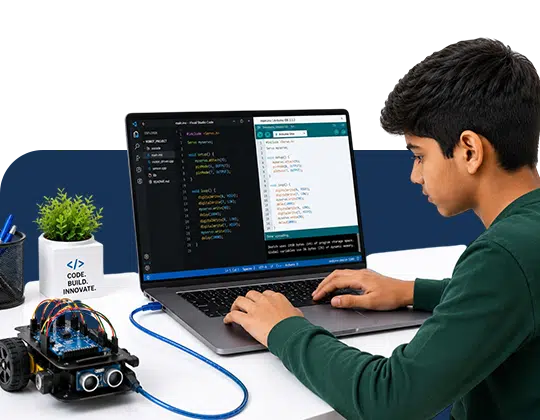
Software stack Arduino IDE, PlatformIO + VS Code, Proteus, Tinkercad, KiCAD, EasyEDA, Fusion 360, Node-RED, MQTT (Mosquitto, HiveMQ), Blynk, ThingSpeak, AWS IoT Core, MIT App Inventor, Python 3, OpenCV, TensorFlow Lite, Edge Impulse, ROS Noetic, Mission Planner, Betaflight, Gazebo, Webots, ArduPilot SITL, Git and GitHub.
Projects You Will Build
Module 1
- mini projects - Smart Home Light & Fan Controller (consumer energy management). - Digital Soil Health & Mini Greenhouse Monitor (precision farming). - Vehicle Reverse-Park Assistant (automotive aftermarket / ADAS). - Industrial Conveyor Object Counter (manufacturing tracking).
- capstone - Smart Home Mini-Hub — multi-zone, multi-sensor smart home controller with PIN keypad arming, gas alarm, occupancy logic and RTC-based scheduling.
Module 2
- mini projects - Cloud-Based Smart Plant Watering System (AgriTech). - Real-Time Air Quality & Pollution Monitor (smart cities, public health). - BLE-Controlled Smart Fan with Speed and Schedule (consumer electronics). - Long-Range Cattle / Asset Tracker using LoRa and GPS (agriculture and transport).
- capstone - Smart Agriculture Monitoring & Control System — multi-node LoRa field network, ESP32 gateway, cloud dashboard, SMS alerts and automatic irrigation.
Module 3
- mini projects - Pet-Companion Mobile Robot (consumer robotics). - Smart Factory Conveyor with Vision-Based Sorting (Industry 4.0). - Surveillance Patrol Robot (security and defense). - AI-Assisted Crop Health Inspector (precision agriculture).
- capstone - Object-Following Smart Robot — Raspberry Pi 4 brain, vision pipeline, PID control, ultrasonic safety, autonomous behaviour around an open space.
Module 4
- mini projects - Agriculture Survey Drone with Live Aerial Streaming. - Defense Recon Mini-Drone with Encrypted Telemetry. - Drone Delivery Concept Prototype with Light Payload. - Custom Embedded Sensor PCB for an IoT product.
- capstone - Custom Industrial Drone Prototype with a student-designed PCB payload, a flown mission and a 5-minute investor-style pitch.
Why Students and Parents Choose Electrobot Senior





Talk to an Elysium Counsellor - We respond within one working day

Trainer & Mentor Section
Every Electrobot Senior trainer is selected against a strict bar:
- Bachelor’s or higher in Electronics, Electrical, Computer Science or related engineering.
- At least 2 years of practical embedded, IoT or robotics experience.
- Hands-on fluency with Arduino, ESP32, Raspberry Pi and drones.
- Comfortable with at least one professional toolchain — PlatformIO, KiCAD or equivalent.
- Demonstrated mentorship or teaching record.
What Past Students Say
Insert verified student testimonial here — include name, school, grade and a 1–2 sentence quote about a specific learning moment. Use real photographs with parental consent for students.
Mrs. Lavanya
Parent of Rythm
Insert verified parent testimonial here — include name, child’s school year, and a sentence about an observable change at home, e.g. “He stopped asking us about gadgets .
Ms. Sharmila
Private School
Insert verified trainer or partner testimonial here — for example from a partner engineering college, an Atal Tinkering Lab coordinator, or a hiring partner.