





Embedron+ - Build Real Industry 4.0 Products. Step Into the Future of Embedded Engineering.

270+ hours of structured lab time on industrial-grade hardware

16 mini-projects and 4 capstone projects across 6 months

Specialization tracks in Agriculture, Manufacturing, Defense and Transport

Industry mentor evaluation and skill endorsement

Trusted curriculum from Elysium Embedded School
Embedron Plus Complete Robotics Training for College Students

Course Introduction

Industry Relevance

Why This Course Matters Now
By the end of Embedron+, you should be able to walk into any embedded product company, IoT startup or robotics R&D lab and contribute from week one. The specific objectives are listed below.









Embedron+ is intentionally advanced. It works best when you already have a basic foundation, so that you can spend your time learning the difficult, valuable parts. Here is who tends to get the most out of it.



Recommended Prerequisites
| Knowledge Area | Expected Proficiency |
|---|---|
| Embedded C Programming | Intermediate — pointers, structures, bitwise operations |
| Microcontroller Concepts | Comfort with Arduino, 8051 or basic AVR programming |
| Digital Electronics | Combinational and sequential logic understanding |
| Serial Protocols | Working knowledge of UART, I2C and SPI |
| Programming Languages | Basic Python, with willingness to learn C++ and Embedded C deeply |
| Tools | Some exposure to Arduino IDE or any simulation/CAD tool |
| Highlight | What It Means For You |
|---|---|
| 6-month structured program | Four 45-day modules, taught at 1.5 hours per day, totaling roughly 270 contact hours. |
| 70% practical learning ratio | You will spend more time in the lab than in lectures, every single week. |
| Four industry tracks | Choose Agriculture, Manufacturing, Defense or Transport from Module 2 onwards. |
| 16+ mini-projects | Short, focused sprints that map to real industrial use cases. |
| 4 capstone projects | One major capstone per module, all integrated into a final Industry 4.0 product. |
| Industrial-grade hardware | STM32, ESP32, Raspberry Pi, NVIDIA Jetson Nano, Pixhawk, LoRa, industrial sensors. |
| Industry mentor sessions | Guest lectures, plant visits and real problem statements every module. |
| Portfolio that placements love | GitHub, video reel, technical docs and investor pitch deck. |
Course Syllabus - Module-Wise Breakdown
Module 1 - Advanced Embedded Architectures and RTOS
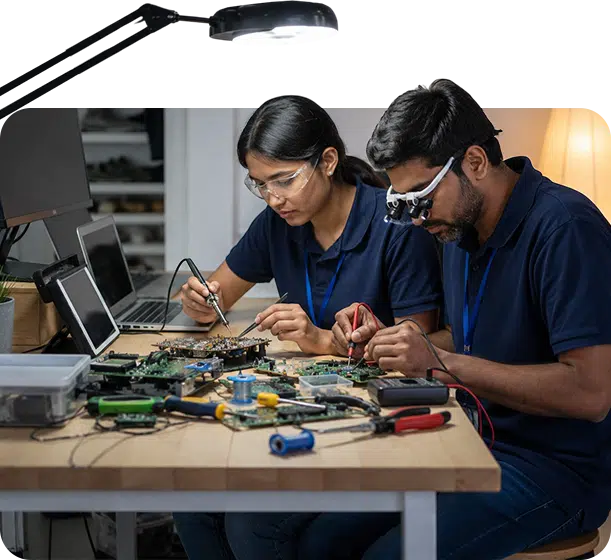
This module takes you from the basics you already know into the world of 32-bit ARM Cortex-M development, real-time operating systems and embedded Linux. By the end, you should be able to design a multi-task RTOS application, build a custom PCB, and bring up a Raspberry Pi for industrial use.
Lesson-Wise Highlights
- Week 1 — ARM Cortex-M architecture, STM32 family, STM32CubeIDE, HAL and LL drivers, GPIO and NVIC.
- Week 2 — Timers, PWM, ADC, DAC, DMA and low-power modes with profiling.
- Week 3 — Advanced communication, I2C deep dive, SPI, CAN bus, RS-485 and Modbus.
- Week 4 — FreeRTOS internals, tasks, queues, semaphores, mutexes, priority inversion.
- Week 5 — Embedded Linux on Raspberry Pi, Yocto introduction, device tree and cross-compilation.
- Week 6 — PCB design with KiCAD, schematic capture, layout, DFM and prototyping.
Skill Outcomes : You will be able to architect 32-bit microcontroller applications, develop multi-tasking RTOS firmware, design and bring up a two-layer PCB, and deploy applications on embedded Linux platforms.
This is where your devices become products. You will learn how to send sensor data securely to AWS or Azure, how to design dashboards engineers actually use, and how to run AI directly on microcontrollers using TinyML. Industry track specialization begins here.
Lesson-Wise Highlights
- Week 1 — IoT vs IIoT, ESP32 deep dive, Wi-Fi, BLE and MQTT broker fundamentals.
- Week 2 — Long-range wireless including LoRa, LoRaWAN, NB-IoT and GSM 4G.
- Week 3 — Cloud IoT with AWS IoT Core, Azure IoT Hub, device shadows and OTA updates.
- Week 4 — Node-RED flows, Grafana dashboards, InfluxDB time-series and alerting.
- Week 5 — Edge AI, TinyML, TensorFlow Lite, model quantization and Edge Impulse workflows.
- Week 6 — Cybersecurity for IoT, TLS, X.509 certificates, secure boot and OWASP IoT Top 10.
Skill Outcomes : You will be able to build a secure, cloud-connected industrial IoT system, train and deploy TinyML models at the edge, and present live dashboards through web and mobile interfaces.
Module 2 - Industrial IoT, Cloud Integration and Edge AI

Module 3 - Autonomous Robotics and Industrial Drones
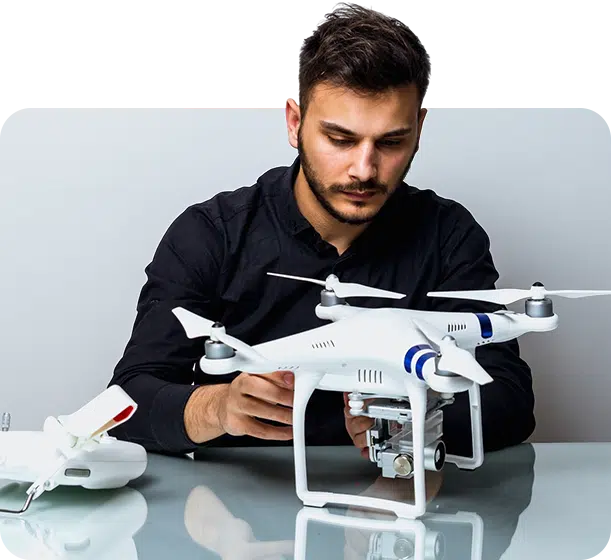
Module 3 is the most demanding and the most fun. You will move from controlling motors to commanding autonomous vehicles, both on the ground and in the air, using ROS 2 and the PX4 or ArduPilot flight stacks.
Lesson-Wise Highlights
- Week 1 — Robotics fundamentals, kinematics, ROS 2 architecture, URDF and Gazebo simulation.
- Week 2 — LIDAR, depth cameras, IMU integration, sensor calibration and TF transforms.
- Week 3 — SLAM, the Nav2 stack, path planning and obstacle avoidance.
- Week 4 — Computer vision, OpenCV, YOLOv8 object detection and ArUco-based control.
- Week 5 — Drone fundamentals, multirotor dynamics, Pixhawk, PX4 vs ArduPilot, DGCA rules and MAVLink.
- Week 6 — Autonomous drones, waypoint missions, GPS-denied navigation and companion computers.
Skill Outcomes : You will be able to design an autonomous ground robot, configure and fly industrial-grade drones, integrate computer vision and execute autonomous missions using ROS 2 and Pixhawk.
The final module is where everything comes together as a real product. You will design an enclosure, cost a BOM, write proper technical documentation and pitch your work to an industry panel.
Lesson-Wise Highlights
- Week 1 — Industry 4.0 pillars, digital twins, OPC UA, SCADA and IEC 62443 cybersecurity.
- Week 2 — Embedded product engineering, BOM costing, DFM, enclosure design in Fusion 360.
- Week 3 — Track-specialized industrial applications across all four verticals.
- Week 4 — Capstone scoping, requirements engineering, risk assessment and sprint planning.
- Week 5 — Capstone development sprint 1, debugging clinics and code reviews.
- Week 6 — Capstone development sprint 2, startup pitch deck and mock technical interviews.
Skill Outcomes : You will be able to integrate the full Embedron+ stack into a deployable Industry 4.0 product, demonstrate startup readiness, and present a job-ready portfolio with documentation.
Module 4 - Smart Systems, Industry 4.0 and Capstone Engineering

Industry & Job Connect
Market Demand
| Industry Vertical | Where Your Skills Apply |
|---|---|
| Agriculture | Precision irrigation, smart farms, drone spraying, livestock monitoring, soil and weather analytics. |
| Manufacturing | Predictive maintenance, smart factory MES integration, industrial robotics, OEE dashboards. |
| Defense | Surveillance robotics, autonomous drones, secure communications, threat detection and border monitoring. |
| Transport | Connected vehicles, fleet telematics, GPS tracking, EV battery management, autonomous navigation. |
| Healthcare Devices | Wearables and patient monitoring devices built on STM32 and connected to secure cloud backends. |
| Smart Cities | Air quality, traffic flow, street lighting and metering systems built on LoRaWAN and cellular IoT. |
Ready to build real products, not just academic projects?
Salary Insights (India, indicative)
Career Growth Opportunities
- Move from engineer to senior engineer to embedded architect over four to seven years.
- Transition into product management, technical sales engineering or solutions architecture.
- Specialized career paths in ADAS, medical embedded, smart-grid or space electronics.
- Launch your own embedded or IoT startup using the capstone as your founding product.
Career Pathways
| Role | Typical Industry | Embedron+ Skill Match |
|---|---|---|
| Embedded Systems Engineer | Product, automotive, medical | Modules 1 + 4 |
| IoT Engineer | Smart city, energy, industrial IoT | Module 2 |
| Edge AI / TinyML Engineer | AI product companies, sensor OEMs | Modules 2 + 3 |
| Robotics Engineer | Industrial robotics, warehouse automation | Module 3 |
| Drone Engineer | Agri-tech, defense, mapping services | Module 3 |
| Industrial Automation Engineer | Manufacturing plants, process industries | Modules 1 + 4 |
| Firmware Engineer | Semiconductor, wearables, industrial | Modules 1 + 2 |
| Hardware Product Engineer | Hardware startups, consumer electronics | Modules 1 + 4 |
Future Roadmap
Advanced Learning Path After Embedron+
- EmbedX industry-professional program for deeper specialization and lateral career moves.
- Advanced track specializations such as ADAS, medical embedded, smart-grid or space electronics.
- Open-source contribution pathway across FreeRTOS, ROS 2, PX4 and Edge Impulse communities.
- Startup incubation through the Elysium startup orientation cell.
- Higher studies in MS or M.Tech in embedded, robotics or applied AI with a strong portfolio.
Certification Roadmap
- Module Completion Certificate after each of the four modules with a score of 70 percent or higher.
- Track Specialization Certificate after a successful capstone in your chosen vertical.
- Embedron+ Advanced Practitioner Certificate for overall completion at 75 percent or higher.
- Internship Readiness Letter for every learner who clears the final evaluation.
- Industry Skill Endorsement for top performers, validated by an external industry mentor panel.
Technology Trends You Will Be Ready For
- AIoT and edge intelligence in industrial environments driving the automated efficiency.
- Software-defined vehicles, connected mobility and EV telematics enhancing fleet operations.
- Autonomous and semi-autonomous drones for civil, agricultural and defense use optimizing aerial surveillance.
- Digital twins and predictive analytics across Industry 4.0 production lines.
- Secure-by-design embedded products driven by IEC 62443 and OWASP IoT standards.
Curriculum Framework
Beginner to Advanced Mapping
- Beginner foundation revisits — pointers, structures, basic peripherals — covered as a warm-up in Module 1.
- Intermediate skills built rapidly in Modules 1 and 2 with RTOS, IoT and cloud integration.
- Advanced specialization in Module 3 with ROS 2, SLAM, computer vision and drone autonomy.
- Industry-ready integration in Module 4 with full Industry 4.0 product engineering.
| Phase | Module | Competency Goal | Output |
|---|---|---|---|
| Foundation | Module 1 | Master 32-bit MCUs, RTOS and Embedded Linux | RTOS app + Linux product |
| Connectivity | Module 2 | Build secure cloud IoT and edge AI | Cloud dashboard + Edge AI device |
| Autonomy | Module 3 | Design autonomous robots and drones with ROS 2 | Autonomous robot + Mission drone |
| Integration | Module 4 | Engineer a track-specialized Industry 4.0 product | Final product + pitch + docs |
Certification Details
| Certification | Issued For | Awarded By |
|---|---|---|
| Module Completion Certificate | Completing each of the four modules with a score of 70 percent or higher | Elysium Embedded School |
| Track Specialization Certificate | Successful capstone in Agriculture, Manufacturing, Defense or Transport track | Elysium Embedded School |
| Embedron+ Advanced Practitioner | Completing all four modules with an overall score of 75 percent or higher | Elysium Embedded School |
| Industry Skill Endorsement | Top 25 percent performers validated by an industry mentor panel | Industry partner with Elysium |
| Internship Readiness Letter | All learners who clear the final capstone evaluation | Elysium Embedded School |
Tools & Technologies Covered

Hardware Stack
STM32 Nucleo, STM32 Discovery, ESP32 DevKit, ESP32-S3, ESP32-CAM, Raspberry Pi 4B, NVIDIA Jetson Nano and Xavier NX, Pixhawk 4 and Cube Orange flight controllers, RPLIDAR, Intel RealSense, Luxonis OAK-D, PLC trainer kits, SX1276 LoRa modules, SIM800L and SIM7600 cellular modems, NEO-M8N GPS receivers, ATECC608A secure elements, industrial sensors across vibration, pressure, soil, gas and current.
Software and Frameworks
STM32CubeIDE, STM32CubeMX, PlatformIO, VS Code, ARM GCC, OpenOCD, FreeRTOS, Yocto, Raspberry Pi OS, ESP-IDF, Arduino ESP32 core, Mosquitto, HiveMQ, AWS IoT Core, Azure IoT Hub, Google Cloud IoT, Node-RED, Grafana, InfluxDB, MongoDB, TensorFlow Lite Micro, Edge Impulse, ROS 2 Humble, Gazebo, RViz2, Nav2, SLAM Toolbox, MoveIt 2, PX4, ArduPilot, QGroundControl, Mission Planner, MAVROS, OpenCV, YOLOv8, PyTorch, Flutter, KiCAD, Fusion 360, OPC UA stacks like open62541, Wireshark, Nmap, Burp Suite, Git and GitHub Actions.
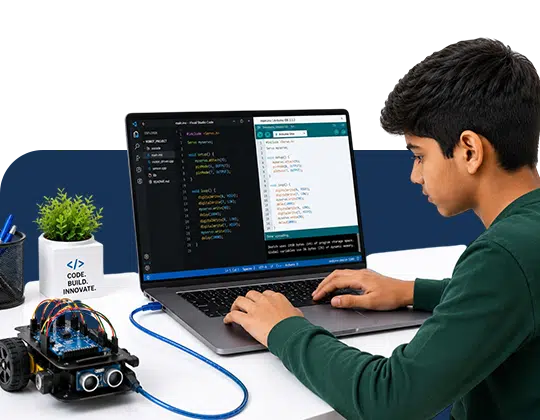
Projects & Case Studies
Selected Mini-Projects
- FreeRTOS-based multi-sensor dashboard for embedded HMI panels.
- Three-node CAN bus network with automotive-style frame structure.
- Yocto-based custom Linux image for Raspberry Pi gateways.
- PCB-based STM32 sensor node fabricated and brought up by you.
- Smart industrial asset tracker with cellular backhaul and geofence alerts.
- Edge AI vibration anomaly detector deployed on ESP32 with TinyML.
- LoRaWAN multi-node precision farm monitoring system.
Module 2 Projects — Scratch Programming
- Module 1 capstone — Multi-protocol industrial sensor hub on STM32 and FreeRTOS, forwarded over CAN to a Raspberry Pi gateway.
- Module 2 capstone — Sector-specialized smart monitoring and control platform with edge AI, cloud and mobile app.
- Module 3 capstone — Autonomous multi-vehicle mission system combining a drone and a ground robot.
- Module 4 final capstone — Track-specialized Industry 4.0 smart product with enclosure, BOM, pitch deck and digital twin.
Why Choose This Course





Talk to an Elysium Counsellor - We respond within one working day
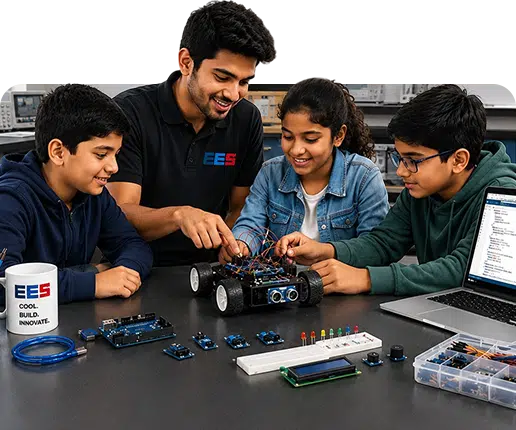
Trainer & Mentor Section
What Our Trainers Commit To
- Preparing every lab in advance and verifying the hardware before each session.
- Maintaining the 70 percent practical to 30 percent theory ratio rigorously.
- Holding daily 10-minute opening reviews and weekly debugging clinics.
- Providing written feedback on every mini-project within five working days.
- Rotating students through equipment roles so no one is left out of hands-on time.
- Enforcing strict drone-safety protocols at all times during Module 3.
Testimonials
The track specialization in Manufacturing helped me focus on predictive maintenance, which is exactly what my recruiter asked me about. The capstone was my interview answer.
Mrs. Kanniga
Parent of Reena
I had no idea I would learn TinyML, ROS 2 and Pixhawk all in one program. Embedron+ packs the equivalent of two years of self-study into six months.
Ms. Shalini
Government College
I came in confident with Arduino but completely new to RTOS and ROS 2. By the end of Embedron+, I had built a working autonomous robot and an IoT product demo in interviews.