






Module 1 - Electrobot Senior Build Real Embedded Products. Master Arduino in 45 Days.

Grades 9–12 • School-aligned curriculum mapped to Industry 4.0

70% lab time — every concept proven on real hardware

15+ lab experiments, 4 mini-projects, 1 capstone Smart Home Hub

Bridge bootcamp for newcomers — nobody gets left behind

Trainer-to-student supervision on every soldering and circuit session
Program Highlights
Start Your Learning Journey With Confidence
- Course Overview
- Course Objective
- Learning Outcomes
- Target Audience
- Course Features
- Industry & Job Connect
Most school-level electronics classes stop at "blink an LED" and call it a day. Module 1 of Electrobot Senior begins where those classes end. Over 45 carefully structured days, students step into the world of advanced Arduino — the same microcontroller family that powers prototypes in defence labs, climate sensors in smart farms, and the early-stage products of every embedded startup in the country.
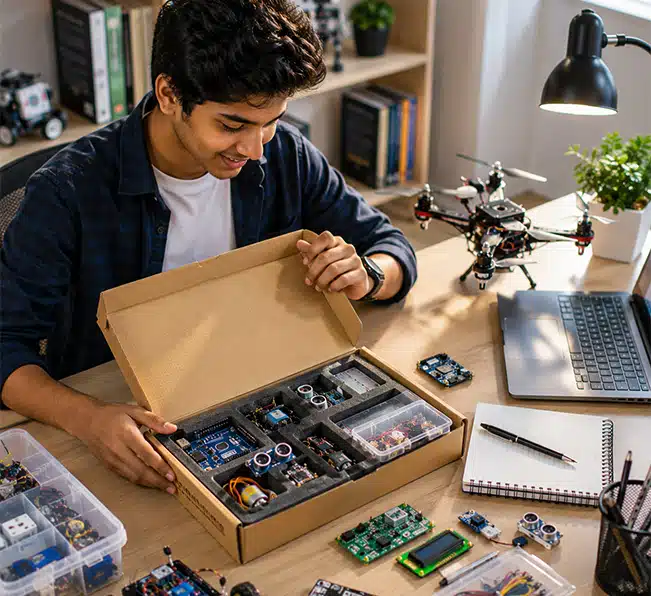
The Arduino course for school students has been engineered as a balanced 70% practical and 30% theory journey. Each daily 1.5-hour session opens with a short concept block, then moves straight to the breadboard. Students wire real DHT22 temperature sensors. They drive servo motors with PWM. They debug I2C bus collisions between two Arduino boards. They build state machines, log data to SD cards, and finish the module with a fully working Smart Home Mini-Hub — keypad-armed, PIR-triggered, gas-leak-alerting, and presentable to peers and parents.
Why this module matters
Embedded systems form the silent backbone of every modern industry. Every car you sit in, every traffic signal you wait at, every health monitor at your local clinic — there is an Arduino-class microcontroller doing real work behind the scenes. Learning Arduino at school is no longer a hobby skill. It is a foundational engineering competency, similar to algebra or essay writing.
Module 1 deliberately bridges what most students already know — basic blink sketches — and what college-level embedded engineers actually do: write modular non-blocking firmware, read sensor datasheets, design schematics, and debug with multimeters. By the time students complete this module, they have spoken the language of real embedded engineers for 67 hours of practical lab time.
Industry Relevance
Every lab in Module 1 is mapped to one of four priority sectors: Agriculture, Manufacturing, Defense, and Transport. Soil moisture monitoring becomes precision farming. Object counting becomes factory production tracking. PIR sensors become perimeter security. Ultrasonic distance sensing becomes a reverse-park assistant. Students do not just learn parts — they learn the industries those parts serve.
Real-World Use Cases Embedded in the Module
- Smart Home Lighting & Fan Controller — energy-aware home automation
- Digital Soil Health Monitor — precision agriculture starter system
- Vehicle Reverse-Park Assistant — entry-level ADAS prototype
- Industrial Conveyor Object Counter — small-factory production tracker
- Smart Home Mini-Hub — module capstone, multi-zone integrated controller
Beginner to Advanced Journey
The module follows a deliberate ladder. Week 1 anchors foundational confidence — GPIO, PWM, interrupts, ADC. Week 2 deep-dives into sensors, calibration, and noise filtering. Week 3 brings motion alive with servos, steppers, and motor drivers. Week 4 unlocks communication protocols — UART, I2C, SPI. Week 5 layers in embedded C mastery: pointers, structs, libraries, and state machines. Week 6 is full system integration as students build their capstone. The final showcase week is for polishing, presenting, and getting feedback — startup-style.
By the end of Module 1, every student will be equipped to:










Technical Skills
- Confident programming of Arduino Uno, Nano, and Mega using Arduino IDE and PlatformIO
- Practical fluency in embedded C — including functions, structs, pointers, header files, and libraries.
- Working knowledge of GPIO, ADC, DAC, PWM, timers, and hardware interrupts.
- Sensor interfacing experience across digital, analog, I2C, and SPI families.
- Motor control proficiency with servos, steppers, and DC motors via H-bridge drivers.


Practical Skills




Portfolio Readiness
Module 1 is built for ambitious learners who want more than a weekend workshop. The Arduino course for school students works best for the following profiles:
School Students (Grades 9–12)
The core audience. Students who have completed Electrobot Junior, or who have basic exposure to Arduino IDE and electronics. Especially valuable for those exploring Computer Science, Electronics, or Engineering as future streams.
Hobbyist Makers
Teenage tinkerers who have built blink-LED projects from YouTube tutorials and want structured progression instead of scattered weekend builds. Module 1 turns scattered curiosity into a real engineering practice.
Atal Tinkering Lab Students
ATL students who want a professionally structured curriculum to complement their school's maker space. Module 1 aligns directly with ATL goals — innovation, design thinking, and hands-on prototyping.
Future Engineering Aspirants
Students targeting top engineering colleges where strong project portfolios increasingly matter. Every lab and project becomes a documented artifact that strengthens college and scholarship applications.
Aspiring Young Founders
Students who already have a startup idea — a smart farm sensor, a home automation gadget, a school-safety device — and want the actual engineering skill to prototype it. Module 1 plus the rest of the Electrobot Senior ladder makes that prototype real.
Career-Curious Teens
Students unsure whether engineering is for them. Module 1 is the lowest-friction way to find out. Most students discover they love it. Some discover it is not their path — and that clarity is itself a valuable outcome.

Live Hands-On Labs

15+ Industry-Style Lab Experiments

Mini-Projects with Real Industry Mapping

Capstone — Smart Home Mini-Hub

Certification

Personal GitHub Portfolio Setup

Lab Logbook & Documentation Discipline

LMS Access & Downloadable Resources

Bridge Bootcamp for Newcomers

Mentor Office Hours

Safety-First Lab Environment

Showcase Day

Current Market Demand
The Indian electronics and embedded systems market is projected to cross 220 billion USD by 2030, with embedded design services alone forecast to grow at a compounded rate above 10 per cent annually. Globally, the embedded systems market is on track to exceed 200 billion USD by the end of this decade. Skilled embedded engineers — including those starting at the Arduino level — are in chronic short supply.

Industry Adoption
Arduino and Arduino-class microcontrollers are the de facto prototyping platform for startups, R&D labs, automotive aftermarket suppliers, and IoT product companies. From the smart agriculture stack at Indian agritech startups to defence research prototypes at DRDO labs, the same skills students learn in Module 1 appear in serious professional engineering work.
Hiring Industries

Cubo



Salary Insights (Indicative — India)
| Role | Experience | Indicative Annual Range (INR) |
|---|---|---|
| Embedded Trainee / Intern | 0 years (school / college) | 1.2L – 3L (stipend) |
| Junior Embedded Engineer | 0–2 years | 4L – 8L |
| Embedded Systems Engineer | 2–5 years | 8L – 18L |
| Senior Embedded Engineer | 5–8 years | 18L – 32L |
| Embedded Architect / Lead | 8+ years | 30L – 60L+ |
| Independent IoT Consultant | Varies | Project-based, 1L – 5L per project |
Ranges are indicative aggregates from public salary portals (Naukri, Glassdoor, AmbitionBox) for Indian metros as of 2025–26. Actual offers vary by company tier, location, and specialisation.
Job Roles Module 1 Begins To Prepare You For
- Embedded Systems Engineer
- IoT Product Engineer
- Hardware Design Engineer
- Firmware Developer
- Robotics Engineer
- Drone Engineer
- PCB Designer (Junior)
- Test & Validation Engineer
- Embedded C Developer

- Field Application Engineer
- Technical Sales (IoT Hardware)
- Maker Space Instructor
- STEM Educator
- EdTech Curriculum Engineer
- Smart Agriculture Product Engineer
- Hardware Startup Founder
- R&D Trainee
- Production Test Engineer
Module 1 is the foundation. Combined with Modules 2 through 4, Electrobot Senior students become competitive for school-level internships and structured early-career pathways through Elysium's Embedron college program.
Freelancing & Global Opportunities
Even at the school level, students who complete Module 1 and publish their work on GitHub and YouTube routinely pick up small paid freelance projects — Arduino-based displays for local shops, automation tweaks for home gardens, science fair builds for younger students. Platforms like Upwork, Hackster, and Tindie also welcome young creators selling original microcontroller-based products to a global maker audience.
Career Pathway
Module 1 is the first deliberate step on a multi-year ladder. The ladder is intentional, structured, and tested across hundreds of Elysium students.
| Stage Name | What You Build | Time Horizon |
|---|---|---|
| Beginner — Module 1 | Foundational embedded skill, Smart Home Hub | 45 Days |
| Intermediate — Modules 2 & 3 | IoT + cloud + robotics + AI vision projects | 3 Months |
| Advanced — Module 4 | Drone + custom PCB + product pitch | 45 Days |
| School Graduate — Electrobot Senior Complete | Portfolio + GitHub + certificate stack | 6 Months Total |
| College — Embedron Program | Real industry projects, internship referrals | Years 1–2 of college |
| Advanced College — Embedron+ | Specialisation: IoT, robotics, drones, AI | Years 2–3 of college |
| Industry — EmbedX Program | Real product launches, founder track | Years 3–4 of college |
| Career | Embedded Engineer, IoT Engineer, Founder, or higher studies abroad | Lifelong |
Role Transition Opportunities
- Embedded Engineer to IoT Architect — typically 3–5 years post-Module 1 foundation
- IoT Engineer to Robotics Engineer — natural lateral move after Modules 2 and 3 in college
- Embedded Engineer to Hardware Startup Founder — increasingly common path from Indian Tier-1 colleges
- Embedded Engineer to Hardware Startup Founder — increasingly common path from Indian Tier-1 colleges
Future Roadmap
Emerging Technologies Students Will Touch in the Full Program
- Emerging Technologies Students Will Touch in the Full Program
- AIoT — the convergence of AI and IoT in agriculture, cities, and consumer products
- Autonomous Mobility — lane following, obstacle avoidance, SLAM at hobby scale
- Drone Swarms — coordinated multi-drone missions
- Cybersecurity for IoT — TLS, secure boot, OTA security
- Industry 4.0 — OPC-UA, smart factory cells, predictive maintenance
- Sustainable Embedded Design — solar-powered nodes, energy-efficient firmware
- Sustainable Embedded Design — solar-powered nodes, energy-efficient firmware
Immediate Next Steps (Within Electrobot Senior)
| Module | Focus | Capstone |
|---|---|---|
| Module 2 | IoT, Wireless Communication & Cloud — ESP32, MQTT, mobile apps, LoRa, GSM | Smart Agriculture Monitoring System |
| Module 3 | Robotics, AI Vision & Autonomous Systems — Raspberry Pi, OpenCV, Edge Impulse, ROS intro | Object-Following Smart Robot |
| Module 4 | Drone Technology & Product Development — drone build, PCB design, productisation, pitch | Custom Industrial Drone Prototype |
Long-Term Industry Evolution
The students starting Module 1 today will graduate engineering college around 2030. By then, embedded engineering will be inseparable from AI, sustainability, and connected mobility. The Arduino habit students build in these 45 days — read the datasheet, draw the schematic, write the firmware, test the circuit, document the work — is the same habit that defines senior embedded engineers a decade from now.
Detailed Syllabus — Weekly Breakdown
| Week | Days | Theme | Concepts Covered | Key Practical Activity |
|---|---|---|---|---|
| 1 | 1–7 | Embedded Foundations | Arduino architecture, GPIO, ADC/DAC, PWM, timers, interrupts | Multi-LED non-blocking patterns |
| 2 | 8–14 | Sensors Deep Dive | Digital & analog sensors, calibration, signal conditioning, noise filtering | Weather monitoring with DHT22 + BMP280 + OLED |
| 3 | 15–21 | Actuators & Motors | Servos, steppers, DC motors, motor drivers, H-bridge | Programmable robotic arm prototype |
| 4 | 22–28 | Communication Protocols | UART, I2C, SPI, Bluetooth basics | Two-Arduino I2C master-slave demo |
| 5 | 29–35 | Embedded C Mastery | Functions, structs, pointers, libraries, state machines | Multi-zone smart lighting controller |
| 6 | 36–42 | Mini Capstone Build | System integration, debugging, documentation | Smart Home Mini-Hub assembly |
| 7 | 43–45 | Showcase & Assessment | Project polishing, viva, presentation, peer review | Final demo day + portfolio submission |
Module 1 - Electrobot Senior— Full Module 1 Build-Out
Module Snapshot
| Attribute | Detail |
|---|---|
| Module Number | M1 |
| Module Name | Advanced Arduino & Embedded Foundations |
| Duration | 45 Days (6 Weeks + Showcase) |
| Learning Level | Intermediate to Advanced (School Level) |
| Prerequisites | Electrobot Junior or basic Arduino familiarity |
| Daily Session | 1.5 Hours |
| Total Learning Hours | Approximately 67 hours |
| Theory : Practical | 30% : 70% |
| Lab Experiments | 15+ |
| Mini Projects | 4 |
| Capstone | Smart Home Mini-Hub |
| Certificate | Certified Embedded Beginner — Arduino Foundations |
Theory Components (30%)
- Arduino board architecture — AVR microcontroller, memory map, registers
- GPIO modes — input, output, input_pullup; bit-level register access
- Analog signals — ADC resolution, reference voltages, sampling theory
- PWM theory — duty cycle, frequency, motor speed control
- Timers and interrupts — hardware timers versus millis(), ISR safety rules
- Communication protocols — UART framing, I2C addressing, SPI clock modes
- Sensor types — passive versus active, analog versus digital, calibration
- Power design — source selection, current ratings, decoupling, regulators
- Industry standards — IEEE serial standards, electrical safety, ESD precautions
- Embedded design principles — modular code, fail-safe defaults, watchdog basics
Practical Components (70%)
- Setting up Arduino IDE, PlatformIO, and VS Code workflow
- Breadboard circuits using best wiring practices and color codes
- Interfacing 10+ sensors with proper calibration
- Driving servos, steppers, and DC motors with appropriate drivers
- Non-blocking, multi-task Arduino code using millis() and state machines
- I2C and SPI communication between two Arduino boards
- Debugging using serial monitor, multimeter, and logic analyzer basics
- Through-hole soldering — joint inspection, desoldering
- Enclosure design with Tinkercad 3D and laser-cut acrylic
- Project documentation — schematics, BOM, code comments, demo videos
Lab Experiments — Full List
| Experiment Title | Industry Use Case |
|---|---|
| Blink Variations and Non-Blocking LED Patterns using millis() | Industrial signaling lamps |
| Reading Analog Sensors (LDR, Pot) with ADC | Smart lighting auto-dim |
| Servo Motor Control with PWM and Potentiometer Feedback | Robotic gripper positioning |
| Reading Temperature & Humidity using DHT22 with OLED Display | HVAC and cold-chain monitoring |
| Ultrasonic Distance Measurement with Buzzer Alert | Vehicle reverse-park sensors |
| Motion Detection with PIR Sensor and Relay-Controlled Lamp | Smart security lighting |
| I2C Communication between Two Arduinos (Master-Slave) | Industrial controller comms |
| Reading IMU Data (MPU6050) and Plotting Angles | Drone & vehicle stability |
| Stepper Motor Control with Limit Switches | CNC and 3D printer axes |
| Current Sensing using ACS712 for Load Monitoring | Industrial energy metering |
| Soil Moisture Sensor with Automatic Watering Pump | Smart agriculture irrigation |
| Multi-Sensor Data Logging to SD Card with Timestamps | Black-box vehicle data loggers |
| Building a State Machine for Traffic Light Controller | Smart-city traffic systems |
| Programmable RGB Strip Patterns (WS2812B) | Industrial mood/status lighting |
| Mini Robotic Arm with 3 Servos using Joystick Control | Pick-and-place automation |
Mini Projects
Mini Project 1 — Smart Home Light & Fan Controller
Mini Project 2 — Digital Soil Health & Mini Greenhouse Monitor
Mini Project 3 — Vehicle Reverse-Park Assistant
Mini Project 4 — Industrial Conveyor Object Counter
Capstone Project — Smart Home Mini-Hub
Capstone Brief
Hardware Provided in Module 1
- Arduino Uno R3, Arduino Nano, Arduino Mega
- DHT22, BMP280, MPU6050, MQ-2 / MQ-135 gas sensors, LDR, soil moisture, ACS712, RTC DS3231
- HC-SR04 ultrasonic, PIR, and IR sensors
- SG90 servo, 28BYJ-48 stepper with ULN2003 driver, DC gear motors, L298N driver
- 4-channel 5V and 12V relay modules
- 16x2 I2C LCD, 0.96-inch OLED, WS2812B RGB strip, 4x4 keypad
- Breadboards, jumper wires, multimeter, soldering iron, USB cables, power supplies
Software Stack Used
- Arduino IDE and PlatformIO with VS Code
- Tinkercad Circuits and Proteus 8 (simulation)
- Fritzing for schematic and breadboard documentation
- Serial Plotter and Logic Analyzer (Saleae or PulseView)
- Git and GitHub for version control
Industry Alignment Matrix
| Sector | Application in Module 1 | Real-World Mapping |
|---|---|---|
| Agriculture | Soil monitoring & automated irrigation | Commercial smart-farm starter kits |
| Manufacturing | Conveyor counters & machine condition sensing | Entry-level industrial counters |
| Defense | Perimeter intrusion sensing with PIR + buzzer | Scaled-down perimeter systems |
| Transport | Reverse-park assistant & in-vehicle sensors | Aftermarket parking systems |
Assessment Structure
| Component | Weightage | What Is Evaluated |
|---|---|---|
| Practical Lab Assessment | 30% | Daily logbook quality, circuit-build accuracy, debugging skills |
| Capstone Project Evaluation | 30% | Working prototype, code quality, documentation, demo |
| Viva-Voce | 15% | Oral examination on theory and concepts |
| Assignments & Quizzes | 10% | Weekly mini-tasks and concept checks |
| Attendance & Participation | 10% | Class engagement, peer support |
| Innovation Score | 5% | Originality and added features beyond the brief |
Five-Pillar Learning Framework
| Pillar | What Happens | Student Outcome |
|---|---|---|
| Discover | Concept introduction through demos, videos, real industry examples | Curiosity and context |
| Design | Block diagrams, flowcharts, schematic planning, system thinking | Engineering mindset |
| Develop | Hands-on circuit building, coding, sensor integration, debugging | Technical skill |
| Deploy | Working prototypes, demonstrations, field testing | Product mindset |
| Disrupt | Innovation, improvement cycles, startup-style pitching | Entrepreneurial thinking |
Theory and Practical Daily Split
| Component | Time Per Day | What Students Do |
|---|---|---|
| Theory | Approximately 27 minutes | Concepts, standards, architectures, protocols, design principles |
| Practical | Approximately 63 minutes | Lab work, coding, hardware interfacing, debugging, demos |
Pedagogical Approach
- Project-Based Learning — every concept is delivered through a working project
- Flipped Classroom Elements — pre-recorded concepts, in-class hands-on time
- Peer Learning — pair programming, team challenges, collaborative debugging
- Failure-Friendly Labs — encouraged experimentation, learning from broken circuits
- Industry Voices — monthly guest sessions from working engineers and entrepreneurs
- Show-and-Tell Culture — every Friday, students demo what they built
Assessment Discipline
- Continuous evaluation — daily logbook scoring, not weekly catch-up
- Capstone grading involves at least two trainers for objectivity
- Written feedback notes per module — not just numeric grades
- Photographs and short videos of every student's capstone retained