





The Convergence Engine: Future Trends in Embedded Systems, IoT & Robotics (2025–2030)
December 3, 2025
ElectROBOT vs Traditional Robotics: The New Standard in Robotics Careers
January 6, 2026
The global industrial landscape is currently undergoing a seismic shift, moving away from manual intervention toward a sophisticated era of autonomous intelligence where machines possess the capability to perceive, process, and perform with human-like precision. As we stand on the precipice of this technological revolution, the global demand for specialized talent has never been more urgent, creating a significant skills gap in sectors ranging from advanced manufacturing to surgical healthcare.
To navigate this complex and rapidly evolving field, aspiring engineers, career changers, and tech enthusiasts must look toward a structured robotics training course that purposefully bridges the widening gap between abstract mathematical theory and the gritty, uncompromising reality of hardware engineering. At Elysium Embedded School.we recognize that a robotics training course is not merely a transient educational program or a series of lectures; it is a profound, career-defining investment in the foundational technologies that will govern the global economy for the next century.
Table of Contents
The Strategic Imperative of a Robotics Training Course
In an age where artificial intelligence is increasingly dominating the digital world through data analysis and generative models, the ability to manifest that intelligence in the physical world through kinetic motion is the ultimate superpower for the modern engineer. This physical manifestation of logic is the core focus of a professional robotics training course.
When you enroll in a robotics training course, you are essentially learning the complex, multi-layered language of machines—a dialect composed of high-speed electronic signals, mechanical torque, and real-time software execution. It is a rigorous, multi-disciplinary journey that requires a deep, intuitive understanding of how electrons move through a meticulously designed circuit, how logic gates process information at nanosecond speeds, and how mechanical linkages translate raw electrical power into smooth, purposeful motion.
Why Choose a Structured Robotics Training Course?
A structured Robotics training course acts as a vital bridge between theoretical academia and high-stakes industrial application. Instead of fragmented learning, it provides a systematic pathway that transforms curious learners into industry-ready robotics professionals who can handle the pressures of a modern smart factory.
End-to-End Systems Integration:
One of the primary advantages of this educational path is learning how to seamlessly integrate disparate mechanical components, complex electronic circuits, and high-performance embedded software into a single, fully functional robotic system. This holistic understanding of “System-of-Systems” architecture is a defining advantage of a structured robotics training course, allowing engineers to oversee projects from the initial CAD design to the final firmware flash.
Hands-On Hardware Proficiency:
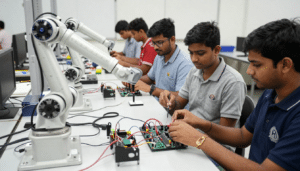
Theoretical knowledge is easily forgotten, but muscle memory from hardware interaction lasts a lifetime. In our lab-intensive robotics training course, you gain direct, practical experience with industrial-grade microcontrollers, diverse sensors, high-torque actuators, and specialized control modules that are commonly used in professional robotics environments. This exposure ensures that you are ready to walk onto a production floor and understand the hardware layout immediately, bypassing the steep learning curve faced by those without such training.
Advanced Logic and Algorithm Development:
Modern automation requires more than just “if-then” statements; it requires adaptive intelligence. A professional robotics training course emphasizes the development of efficient, intelligent algorithms that control robotic behavior in dynamic, unpredictable environments. By focusing on logical thinking, mathematical optimization, and scalable system design, our robotics training course prepares you to write code that is not only functional but also robust, secure, and energy-efficient.
Real-World Troubleshooting and Debugging Skills:
In the world of hardware, things rarely work on the first try. Mastering the critical skill of identifying and resolving hardware-software conflicts is a core pillar of our philosophy. Unlike textbook learning, a robotics training course develops hands-on debugging expertise—using tools like logic analyzers and oscilloscopes—which is absolutely essential for success in high-budget robotics projects where downtime can cost thousands of dollars per hour.
Laying the Foundation: Robotics Courses for Beginners
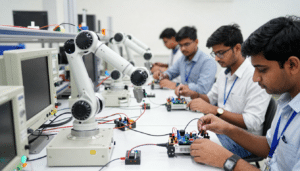
The path to becoming a world-class robotics expert can often feel daunting due to the sheer volume of information required, which is why specialized robotics courses for beginners serve as the essential, low-friction entry point for those with limited technical backgrounds. A well-structured robotics training course for novices focuses specifically on demystifying the perceived complexity of automation by breaking down large systems into manageable, understandable units. It begins by teaching the fundamental “alphabet” of robotics: the behavior of resistors, the energy storage of capacitors, and the switching capabilities of simple logic gates.
In our robotics training course, we maintain the firm belief that every industry expert was once a beginner who simply refused to give up in the face of a challenging bug. This is why our robotics courses for beginners are not isolated modules but are integrated directly into our larger, more comprehensive robotics course ecosystem to ensure a smooth transition to advanced topics.
Key Learning Milestones in Robotics Courses for Beginners
Fundamentals of Electronics:
Every student begins by gaining a crystal-clear understanding of voltage, current, and resistance—the foundational elements that power every robotic system on the planet. This knowledge forms the indestructible backbone of any effective robotics training course, as it prevents common mistakes like blowing out expensive microcontrollers due to incorrect voltage levels.
Core Programming Skills in C and C++:
While many hobbyists start with visual blocks, a professional robotics training course introduces learners to the industry-standard languages of C and C++. This stage introduces vital control structures, memory management, and efficient coding practices that are the universal standard for everything from micro-drones to massive industrial robotic arms.
Basic Actuation and Motor Control:
Theory meets reality as students begin by controlling a single motor to understand the nuances of motion, speed, and direction. This step bridges the gap between a line of code and a physical rotation, serving as the first “win” in any robotics training course and preparing learners for the complexities of multi-axis robotic systems.
Sensor Integration and Environmental Awareness:
A robot without sensors is just a machine; a robot with sensors is an autonomous agent. By interfacing essential modules such as IR and ultrasonic sensors, learners enable their machines to detect obstacles and respond dynamically to their surroundings. This milestone introduces the pivotal concept of “perception” which is a core theme throughout our robotics training course.
Detailed Syllabus Overview of Our Robotics Training Course
Our robotics training course is meticulously architected to take you from a curious enthusiast to a highly competent, industry-ready engineer. We have organized the curriculum into five core technical pillars, each focusing on a critical domain of modern automation and ensuring that you have a 360-degree view of the field.
Module 1: Introduction to Electronics
Every professional robotics training course must start with the fundamental laws of physics that govern electronic behavior. In this module, we purposefully strip away the complexity of modern gadgets to understand the movement of electrons at a granular level. You will master components like resistors, capacitors, and transistors, which collectively form the nervous system of any machine.
This stage is particularly vital for those enrolled in our robotics courses for beginners, as it teaches you how to accurately read complex circuit diagrams and use professional diagnostic tools like multimeters and oscilloscopes to “see” electricity. By the end of this foundational module in the robotics training course, you will be able to design and build stable, regulated power supplies for your robotic platforms, ensuring they operate safely and reliably.
Module 2: Microcontroller Programming and Architecture
This module represents the “brain” transplant of our robotics training course. We move beyond simple, entry-level hobbyist boards to explore the sophisticated internal architectures of 8051, AVR, and high-performance ARM Cortex-M microcontrollers. You will learn the art of writing highly efficient, low-level code in Embedded C—the language of choice for the global robotics industry.
A significant and challenging portion of this robotics training course segment is dedicated to interrupt-driven logic and register-level programming. Whether you are aiming for a comprehensive Robotics Certification course or just starting your journey, mastering how a processor handles real-time tasks with microsecond precision is what truly separates a student from a professional engineer.
Module 3: Advanced Sensor Integration
A robot is only as intelligent as its perception of the surrounding world. In this critical phase of the robotics training course, we interface a wide and diverse array of digital and analog sensors. You will learn how to process raw data from ultrasonic sensors for obstacle avoidance, IR sensors for high-speed line tracking, and 6-axis IMUs ( and accelerometers) for sophisticated balance and orientation.
Understanding the intricacies of signal conditioning and noise reduction is a technical highlight of our robotics training course. By learning how to fuse data from multiple disparate sources, you will give your robot the ability to “feel” its environment with extreme precision—a core requirement of any advanced Robotics Certification course.
Module 4: Precision Motor Control and Kinematics
Purposeful movement is the defining characteristic of any robotic system. This module of our robotics training course focuses heavily on the mechanics of motion. You will dive deep into the theory and application of to control the speed and direction of DC motors, high-precision Stepper motors, and high-torque Servos.
However, a robotics training course at Embedded School goes further than mere motor spinning by introducing the complex mathematics of kinematics. You will study how to calculate joint angles and end-effector positions using trigonometric models, ensuring that your robot moves with mathematical grace and industrial repeatability rather than erratic, unpredictable jerks. This is often described as the most rewarding part of the robotics training course for our students.
Module 5: Wireless Communication and IoT
In the modern industrial era, robots no longer operate in isolation; they are part of a massive, interconnected web. The final module of our robotics training course covers the vital connectivity that drives the Industry 4.0 revolution. You will explore a variety of wireless protocols, including Bluetooth for short-range localized control, Wi-Fi (using ESP8266 and ESP32 platforms) for cloud integration, and LoRaWAN for long-range industrial applications.
This technical breadth ensures that your robotics training course experience stays perfectly relevant to the “Connected World” trend. By the end of this module, you will have built a robot that can be monitored and controlled from across the globe via a custom web interface, serving as a fitting and impressive capstone for your Robotics Certification course.

The Professional Weight of a Robotics Certification Course
In the highly competitive corporate world, evidence of practical skill is the primary currency of recruitment and career advancement. This is where a formal Robotics Certification course becomes an invaluable asset for your professional portfolio. While anyone can claim to know how to build a basic robot in their garage, a Robotics Certification course from a reputable institution like Embedded School provides essential third-party validation of your technical expertise. When a hiring manager sees that you have successfully completed a rigorous and comprehensive robotics training course, it significantly reduces the perceived risk of hiring you for a high-value engineering role.
Benefits of a Robotics Certification Course
- Standardized Knowledge Base: Completing a Robotics Certification course ensures you meet the global benchmarks and standardized practices required by high-tech firms after your robotics training course.
- Resume Impact and Visibility: A recognized Robotics Certification course acts as a powerful, positive signal to both automated HR algorithms and discerning hiring managers looking for specialized talent.
- Practical Project Validation: It proves beyond a doubt that you have completed rigorous, real-world projects—a mandatory part of our robotics training course—rather than just memorizing theoretical concepts.
- Higher Salary Potential: Data consistently shows that graduates of a specialized Robotics Certification course often command premium starting packages and reach senior-level engineering positions faster than their uncertified peers..
Career Pathways After a Robotics Training Course
The ultimate objective of enrolling in a professional robotics training course is to secure a rewarding, high-impact, and future-ready career in a sector that values your specialized skills. A well-structured Robotics Certification course equips learners with industry-relevant expertise that is highly transferable across multiple high-growth technology sectors. Graduates of our robotics training course programs can explore a wide variety of diverse career pathways, including:
- Industrial Robotics Engineer: Focus on programming, operating, and maintaining the complex robotic systems used in automotive manufacturing and electronics assembly lines.
- Embedded Systems Engineer: Specialize in developing and optimizing the mission-critical firmware and control logic that powers the next generation of robotic systems. This career path is a core focus of our advanced robotics training course
- Automation Consultant: Help global organizations design and implement smart automation strategies to enhance productivity and reduce operational costs across their supply chains.
- Research and Development Engineer: Contribute to global innovation by working on cutting-edge robotics technologies involving artificial intelligence, computer vision, and autonomous navigation.
Frequently Asked Questions (FAQs)
1. Is a robotics training course suitable for working professionals?
Absolutely. Many experienced engineers take a robotics training course specifically to upskill and move into the rapidly growing automation or embedded systems sectors. Our flexible scheduling ensures you can balance your robotics training course with your current job responsibilities.
2. What specific projects will I build during the Robotics Certification course?
In our robotics training course, you will build a progression of increasingly complex machines, ranging from simple line-following robots and autonomous rovers to complex IoT-controlled robotic arms and multi-sensor fusion systems.
3. Do I need a prior engineering degree for robotics courses for beginners?
No, our robotics courses for beginners are specifically designed to take you from zero to hero. The robotics training course starts with the absolute basics of logic and electronics to ensure no student is left behind, regardless of their previous background.
4. How does this robotics training course help with job placements?
By providing a recognized Robotics Certification course and documented real-world project experience, we make our students highly attractive to top-tier tech firms. Our robotics training course graduates often receive priority in hiring due to their verified practical hardware skills.
5. How long does it take to complete the core robotics training course?
Depending on the intensity of the track you choose, most students successfully complete the core robotics training course within 3 to 6 months of dedicated study and intensive lab work.
Conclusion
The journey toward mastering automation is a marathon, not a sprint, and the quality of your starting line determines the ultimate trajectory and height of your career. By choosing a comprehensive robotics training course at Elysium Embedded School, you are ensuring that your education is practical, professional, and entirely future-proof in an increasingly automated world. Whether you are starting with robotics courses for beginners to learn the fundamentals of electronics or aiming for a specialized Robotics Certification course to validate your advanced expertise, the key is to begin with a rock-solid, first-principles foundation. A well-structured robotics t course provides the mentorship, industry-standard equipment, and hardware access that self-study or online-only videos simply cannot replicate.
At our institute, we believe that the best robotics course is one that challenges you to solve real-world industrial problems in a supportive, expert-led environment. Our curriculum is meticulously designed to move far beyond dry theory, allowing you to interact with advanced microcontrollers and sensors in a professional lab setting. By completing this robotics course, you gain the technical confidence and the analytical mindset needed to design, program, and maintain complex autonomous systems. This hands-on approach is why our Robotics Certification course is highly regarded by global employers looking for engineers who can contribute to high-stakes projects from day one.


